
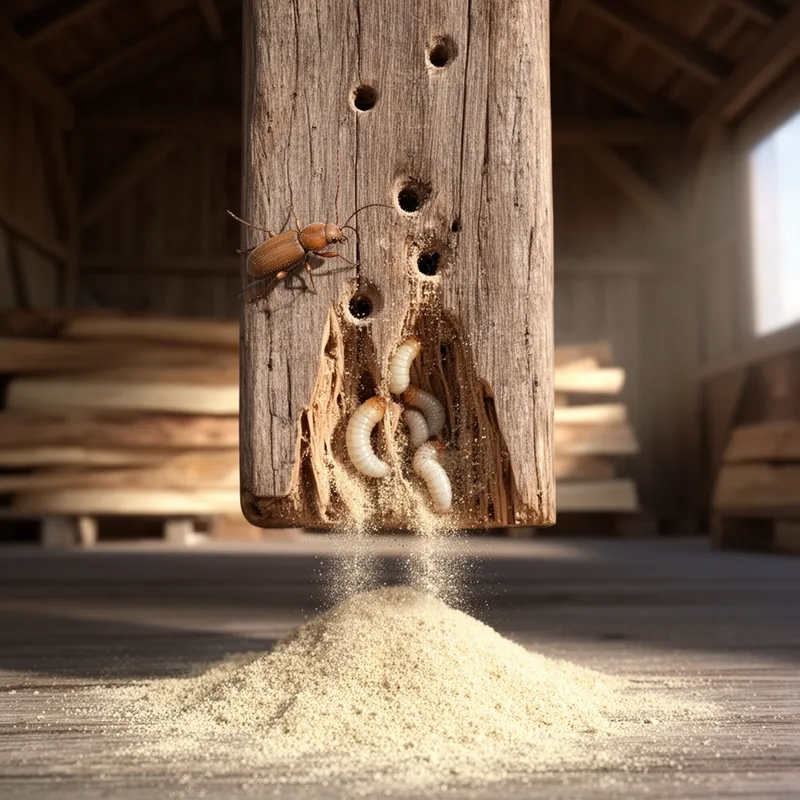
powder-post beetle
- noun
- Specialized
- Furniture makers take precautions against powder-post beetles when storing timber.
Examples
-
He discovered a small pile of dust, a sign that powder-post beetles had attacked the wood.
-
The old barn was infested with powder-post beetles that weakened its beams.
-
The powder-post beetle is a significant pest for wooden structures.
-
Many homeowners are unaware of the powder-post beetle damage.
-
The powder-post beetle larvae can weaken wooden structures by creating fine dust as they digest the wood.
-
Homeowners need to watch for signs of powder-post beetles to prevent serious damage to their furniture.
-
After discovering powder-post beetles in the attic, he immediately called a pest control service to eliminate them.
How Damaging


Surface Forms
Morphology
powder-post + beetle
The head noun 'beetle' is transparent (an insect), and the modifier includes 'powder' which gives a clue that the insect is associated with powder-like damage to wood; however 'powder-post' is a conventionalized compound (and the role of 'post' is not literally obvious) so the exact meaning (wood‑boring larvae that reduce timber to powder) is not fully predictable without prior exposure. Because part of the sense is derivable but the compound is lexicalized and partly opaque, this is best classified as semi-transparent.
Etymology
Powder-post beetle gets its name from what it does: the young beetles eat wooden posts and leave behind fine powder or dust. So the name means 'a beetle that turns wood into powder', which is why it refers to beetles that damage wood.