
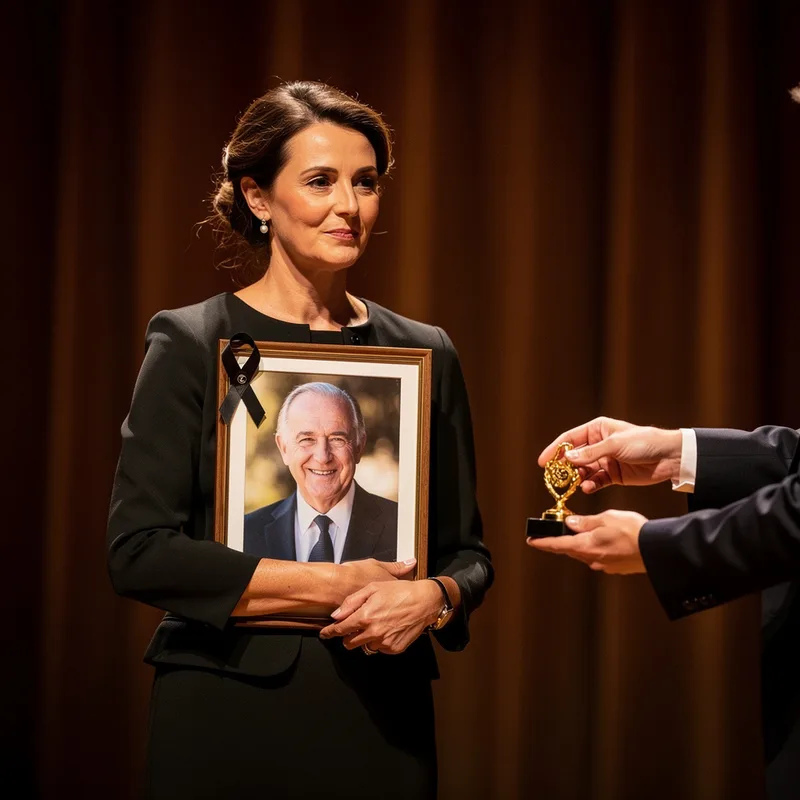
posthumously
 13
7.2

- adverb
- /ˈpɑstʃəˌməsli/
- It was awarded to him posthumously.
- published posthumously
- awarded posthumously
- posthumously published book
Loading YouTube…
Watch on YouTubeSo the poem has been published posthumously by his good friend Charles, with notes explaining its meaning.
- So the poem has been published posthumously by his good friend Charles, with notes explaining its meaning.
- He was posthumously awarded the Pulitzer Prize and non fiction for his book The Denial of Death.
- Caesar posthumously, and this is a little weird, posthumously adopts Octavian as his son.
- That's kind of a fix up too in a way posthumously, isn't it?
- And although it is posthumously made, I don't see it as a posthumous paint painting.
Examples
-
Sorrel wrote Recollections of a Confederate Staff Officer, which was published posthumously in 1905.
Academic text (2007) -
So the poem has been published posthumously by his good friend Charles, with notes explaining its meaning.
-
Has the Student Academy Award ever been won posthumously?
-
Which is usually awarded posthumously.
-
For his service, he was posthumously presented the Navy Cross and Purple Heart as per the following citation:
Academic text (2007) -
In England after the war, Thompson went on writing poems, most of which were collected posthumously in Poems 1950-1974.
Academic text (2009) -
He was posthumously awarded the Purple Heart for gallantry.
-
He was posthumously awarded the Pulitzer Prize and non fiction for his book The Denial of Death.
-
His richly detailed book, America's Sporting Heritage, 1850-1950 (1974), published posthumously, displayed the erudition typical of his research.
Academic text (1991) -
He was posthumously awarded the Pulitzer Prize for his outstanding work in literature.
Surface Forms
Morphology
posthumously = posthumous (transparent) = posthumous + ly
The adverb is a regular formation from the adjective 'posthumous' by adding '-ly', so its adverbial meaning 'after death' is directly derived.
Etymology
Posthumously comes from two parts: post- meaning 'after', the same post- you see in postpone and postwar, and humus meaning 'ground' or 'earth', so it originally meant 'after burial'. That's why something done posthumously happens after a person's death.