

posterior horn
- noun
- /ˌpoʊstɪˈɪr hɔrn/
- Specialized
- Damage to the posterior horn can result in loss of sensory function below the injury site.
Examples
-
The posterior horn of the spinal cord receives input from sensory neurons.
-
In the spinal cord, the posterior horns contain sensory nerve fibers.
-
Inflammation in the posterior horn is often associated with certain neurological diseases.
-
The posterior horn plays a crucial role in sensory processing.
-
Damage to the posterior horn can result in loss of sensory function below the injury site.
-
The posterior horn of the spinal cord receives input from sensory neurons.
-
In the spinal cord, the posterior horn contains sensory nerve fibers that transmit signals to the brain.
Synonyms


 1
7.7
1
7.7
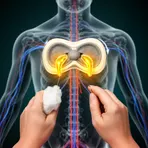
A part at the back of the spinal cord that receives signals from nerves for touch and pain
Surface Forms
Morphology
Both constituents are literal and compositional: 'posterior' means 'at the rear' and 'horn' denotes a projecting part, so an average B1 learner who knows those words can infer this refers to a rearward projecting part (in this case an anatomical structure). Although the full neuroanatomical specifics (gray matter, sensory fibers) are technical, the basic spatial/shape meaning is directly derivable from the parts.
Etymology
Posterior horn comes from a clear picture: posterior means 'back' and horn describes a small horn-shaped part of the spinal cord. Because this little 'horn' sits at the back and receives signals from sensory nerves, posterior horn now refers to the back part of the spinal cord that takes in 'senses' like 'touch'.