
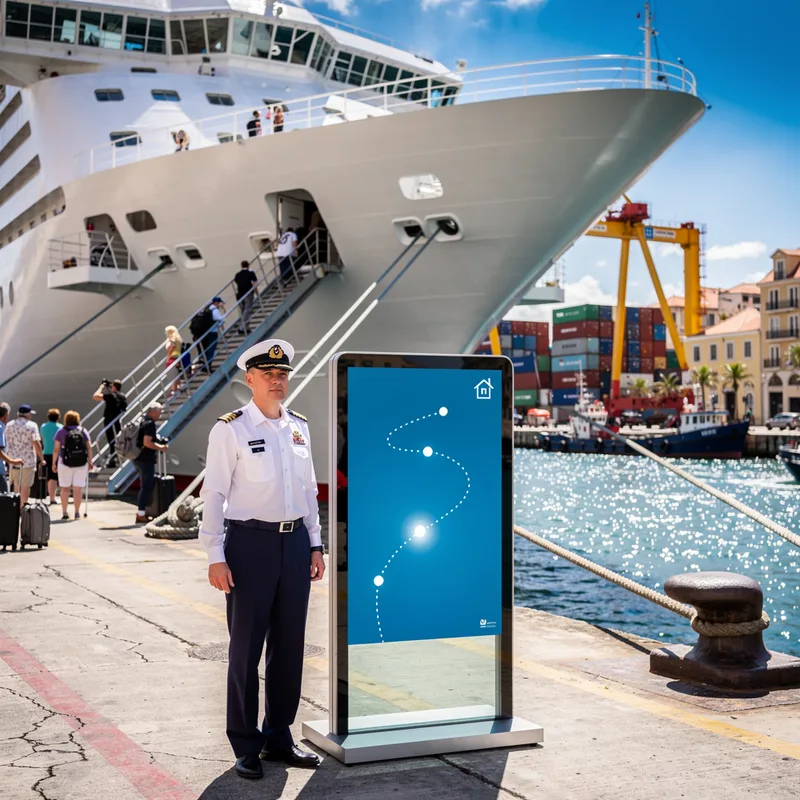
port of call
 6
3.4
6
3.4

- noun
- /pɔrt əv kɔl/
- The Wanderer reached its first port of call, Port of Spain, Trinidad, in eighteen days.
- the first port of call
Loading YouTube…
Watch on YouTubeBut the first port of call for many is OK, cut head count, cut quality, reduce pay, you know, get rid of this benefit.
- But the first port of call for many is OK, cut head count, cut quality, reduce pay, you know, get rid of this benefit.
Examples
-
Your first port of call's not Delhi, it's Mumbai.
-
You will be put ashore safely at a British port of call at the first opportunity.
-
-So, what's the next port of call?
-
NHS and independent hospitals would be your first port of call.
Blog text (9) -
So I forgot about it and started contemplating my next port of call.
Fiction book (1991) -
There's no doubt about it, LinkedIn should be the first port of call for any pre-interview research.
Blog text (2) -
Although patients will be reviewed regularly at their local rheumatology unit, you will often be the first port of call for someone experiencing an exacerbation of symptoms.
Academic text (2014) -
Vietnam was our fourth port of call, and Balaban had joined us in Hong Kong, our previous landing, as an interport lecturer.
Fiction book (1999) -
During our cruise, Barcelona will be the first port of call before we head to Rome.
-
The ship's itinerary included several exciting ports of call around the Caribbean.
Synonyms
 14
2.2
14
2.2
A town or city by the sea where ships load and unload things and people
Surface Forms
Morphology
The meaning 'a port where a ship stops' is directly derivable from combining 'port' (harbor) with 'call' (a visit/stop) linked by 'of', so the overall sense is a harbour at which a vessel calls. This noun-of-noun composition is a common, cross-linguistic pattern, so a B1 learner who knows the constituent words should be able to infer the MWE meaning.
Etymology
Port of call comes from old sea travel. It paints a simple picture of a ship stopping at a port to 'call', that is, to make a short visit for supplies or passengers, so today it means 'a place where a ship stops during a journey'.