

port-access coronary bypass surgery
- noun
- /pɔrt ˈæksɛs kəˈrɒnəri ˈbaɪpæs ˈsɜrdʒəri/
- Specialized
- He underwent port-access coronary bypass surgery to treat his severe coronary artery blockages.
Examples
-
The cardiologist explained that port-access coronary bypass surgery would result in smaller scars and a quicker recovery.
-
Advancements in technology have made port-access coronary bypass surgery a viable option for many patients.
-
Dr. Smith performed a port-access coronary bypass surgery yesterday.
-
Have you heard about port-access coronary bypass surgeries?
-
Recent studies show that port-access coronary bypass surgery reduces the recovery time compared to traditional methods.
-
Patients prefer port-access coronary bypass surgery because it minimizes the risk of complications associated with larger incisions.
-
After his port-access coronary bypass surgery, the doctor monitored his progress closely to ensure a smooth recovery.
Synonyms

 3
4.4
3
4.4

Surgery that uses a blood vessel to carry blood past a blocked heart artery and restore blood flow
 1
4.2
1
4.2
An operation using a healthy blood vessel to go around a blocked artery in the heart and restore blood flow
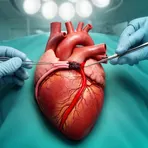 1
4.6
1
4.6
A surgery that uses a healthy blood vessel to go around a blocked heart artery and restore blood flow
Surface Forms
Morphology
port-access + coronary + bypass + surgery
The core elements 'coronary' + 'bypass' + 'surgery' transparently indicate a heart operation to create a passage around blocked arteries, so a learner would grasp it is a type of heart operation. However, the modifier 'port-access' is a technical compound; its precise procedural sense (using small ports/instruments and specific access techniques) is specialized and not predictable for an average B1 learner, so the overall phrase is only partially transparent.
Etymology
Port-access coronary bypass surgery gets its name from the idea of port-access, where surgeons work through small 'ports', that is tiny openings, to reach the heart with long tools and a camera instead of opening the chest wide. So the name helps you picture a coronary bypass done through tiny openings, which explains the 'smaller scars' and a quicker recovery.