

polymyositis


 1
9.9
1
9.9
- noun
- /ˌpɒlɪˌmaɪəˈsaɪtɪs/
- Specialized
- The mainstay of treatment for polymyositis is corticosteroids.
- patients with polymyositis
Examples
-
The clinical diagnosis of polymyositis can be confirmed by three tests: serum muscle enzymes, electromyography, and muscle biopsy.
Academic text (2007) -
Polymyositis and its complications, such as weakness of oropharyngeal muscles leading to dysphagia and life-threatening risk of aspiration pneumonia, should be recognized early and managed effectively.
Academic text (2007) -
The prevalence of polymyositis is estimated to be 1 per 100,000.
Academic text (2007) -
The patient also experienced severe myalgia and muscle tenderness, which is typical in 30% of patients with polymyositis.
Academic text (2007) -
Myalgia and gross generalized edema can be the presenting signs in polymyositis.
Academic text (2007) -
Overall, the prognosis of polymyositis is good, with a 5-year survival of 95% and a 10-year survival of 84%.
Academic text (2007) -
Polymyositis is an inflammatory myopathy in which the pathogenesis is presumed to be autoimmune.
Academic text (2007) -
Polymyositis was first recognized in 1887 by Wagener and Unverricht in patients presenting with muscle weakness and skin lesions.
Academic text (2007) -
The mainstay of treatment for polymyositis is corticosteroids.
-
The patient also experienced severe myalgia and muscle tenderness, which is typical in 30% of patients with polymyositis.
Synonyms
 1
9.9
1
9.9
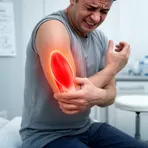
Swelling and pain in a muscle that make the muscle weak
How Severe

Surface Forms
Morphology
polymyositis = myositis (semi-transparent) = poly + myo + itis
Adding poly- transparently changes 'muscle inflammation' to inflammation affecting multiple muscles.
Etymology
Polymyositis comes from Greek parts: poly- 'many', myo- 'muscle', and -itis 'inflammation', and you can see poly- in polygon which means 'many sides' and -itis in arthritis which means 'joint inflammation'. So polymyositis is inflammation of many muscles, which is why it causes muscle weakness and pain.