
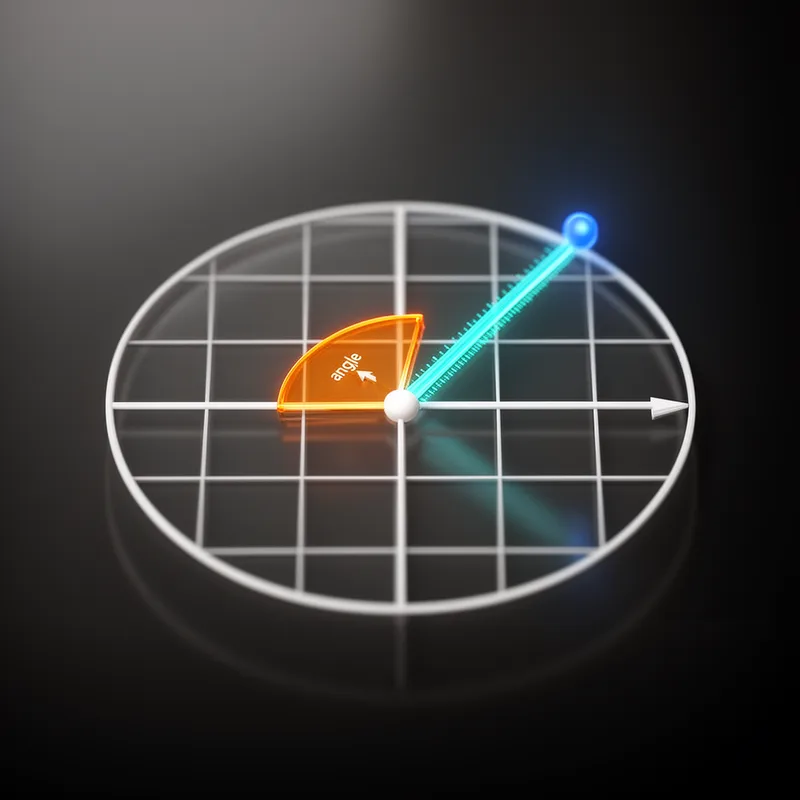
polar coordinate
 1
7.5
1
7.5

- noun
- /ˈpoʊlər kɔːrˈdɪnət/
- Specialized
- Using polar coordinates, you can easily identify the location of a point by specifying its distance from the origin and its angle.
- using polar coordinates
- relative and polar coordinates
Loading YouTube…
Watch on YouTubeNow let's just because there's a central point of this problem, the natural coordinate system to use is polar coordinates in the plane.
- Now let's just because there's a central point of this problem, the natural coordinate system to use is polar coordinates in the plane.
Examples
-
When using polar coordinates, a ruler and protractor may be used to find estimated numbers, but geometry and trigonometry are used to find the precise points needed for accurate CNC cuts. G & M codes are written in lines of code that are formatted for specific machines.
Academic text (2011) -
Then over here we have applications of trigonometric functions, polar coordinates and vectors.
-
When using polar coordinates, write your G & M Code from the relative points.
Academic text (2011) -
Figure 2. Example angle used for determining polar coordinates.
Academic text (2011) -
Because polar coordinates are based on relative points, the given part is fairly easy to write the angle in degrees and distance.
Academic text (2011) -
Area of a triangle in polar coordinates looks like this in polar coordinates.
-
With polar coordinates, the relationships are more conceptual and difficult to calculate.
Academic text (2011) -
Find and describe locations on maps with rectangular and polar coordinates.
Academic text (2013) -
Well, when you're talking about polar coordinates, the X coordinate is R and the Y coordinate is Theta.
-
Students will need to be taught the algebraic and trigonometric calculations needed for polar coordinates, including the inverse tangent functions on a calculator.
Academic text (2011)
Synonyms
 407
4.5
407
4.5
A number that shows where a point is on a map or graph
Surface Forms
Morphology
The parts give helpful cues: 'coordinate' signals a numeric value for position and 'polar' indicates relation to a pole or polar system, so a learner can infer this is a coordinate expressed with respect to a pole. However, the precise idea that it consists of two values (radius and angle) and the exact geometric interpretation are technical and not fully predictable from the constituents alone, making the term only partially transparent to a B1 learner.
Etymology
The term polar coordinate comes from a simple picture: the word polar points to a fixed 'pole' like the North Pole at the centre, and the word coordinate is the value that shows how far and which way a point is from that pole. So the two values, the 'distance' and the 'angle', together tell exactly where the point is.