

poetic license
 2
6.7
2
6.7

- noun
- /poʊˈɛtɪk ˈlaɪsəns/
- Literature
- In his song, the musician took poetic license to portray the city as a magical place.
- take poetic license
- use poetic license
Examples
-
While there are some songs that are unscriptural (and we have never seen any songbook totally exempt from all criticism), we certainly do believe in poetic license.
Blog text (18) -
Even soon afterward, poetic license was not only allowed, it was expected.
-
- I was taking poetic license.
-
- I take poetic license.
-
I would be the first to agree that there is such a thing as poetic license.
Academic text (2010) -
I used a little poetic license to capture your essence.
-
Rattles is defining poetic license here as against literal truth.
-
While weak poets distastefully evaded the difficulty of fixed forms through poetic license, strong poets had sufficient ingenuity to follow the form's rules with grace.
Academic text (2017) -
As a writer, she felt free to use poetic license to enhance the emotion of her story.
-
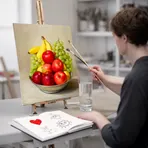
The artist's latest painting clearly demonstrates his use of poetic license in blending reality with imagination.
Synonyms
 83
7.2
83
7.2
Freedom to act without following normal rules, often in behavior or art
Antonyms

- Literature

 1
8.2
1
8.2
A way of making art or writing that shows things exactly as they are, not using symbols
How Free

Surface Forms
Morphology
The meaning is directly inferable from combining 'poetic' (relating to poetry, artistic expression) with 'license' (permission or freedom): it denotes a permission to be poetic or to bend rules for artistic effect. This compositional pattern is common cross-linguistically (e.g. Spanish 'licencia poética'), so a B1 learner who knows both constituents would likely grasp the intended sense.
Etymology
Poetic license uses poetic (art) and license ('permission') to paint a picture of a writer given special 'permission' to bend facts or grammar to make a poem or story feel stronger. That's why it means the freedom to change rules or facts in writing or art to get a better effect.