

pneumatic drill


 1
5.0
1
5.0
- noun
- /njuˈmætɪk drɪl/
- Specialized
- There she discovered experiments with Swedish workers using pneumatic drills to explore the effects of strong vibrations on humans, and she reported on these as issues related to her topic.
- using a pneumatic drill
Examples
-
He wore ear protection while operating the pneumatic drill to minimize the loud noise.
-
Using a portable pneumatic drill, he bored a hole into the rock.
Fiction book (2001) -
Sol, do we have a pneumatic drill?
-
Standing on a mountain of rusted engines, pneumatic drills, and other equipment, Ripley rummaged through miles of wire, tubing, and spare parts.
Fiction book (1992) -
Men are tearing up the asphalt; they're in pits banging away with pneumatic drills.
Fiction book (1992) -
The construction crew used a pneumatic drill to break up the old concrete pavement.
-
During the renovation, they employed a pneumatic drill to create holes for the new electrical wiring.
Synonyms
 24
4.9
24
4.9
A heavy tool that breaks concrete and other hard surfaces
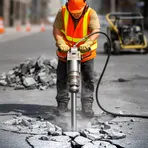
A heavy tool that uses air to break concrete or rock
Surface Forms
Morphology
The noun phrase is directly compositional: 'pneumatic' (operated by air or gas pressure) modifies 'drill' to mean a drill powered by compressed air, so a learner who knows both words can infer the meaning. This adjective + noun pattern is standard and cross-linguistically common, making the expression immediately understandable to learners.
Etymology
Pneumatic drill is named for how it works: pneumatic comes from a word for 'air', and drill is a tool that breaks hard ground or makes holes. Because it is powered by squeezed air, the name gives the clear image of a tool that 'runs on air', which helps remember why it is used to break concrete and roads.