
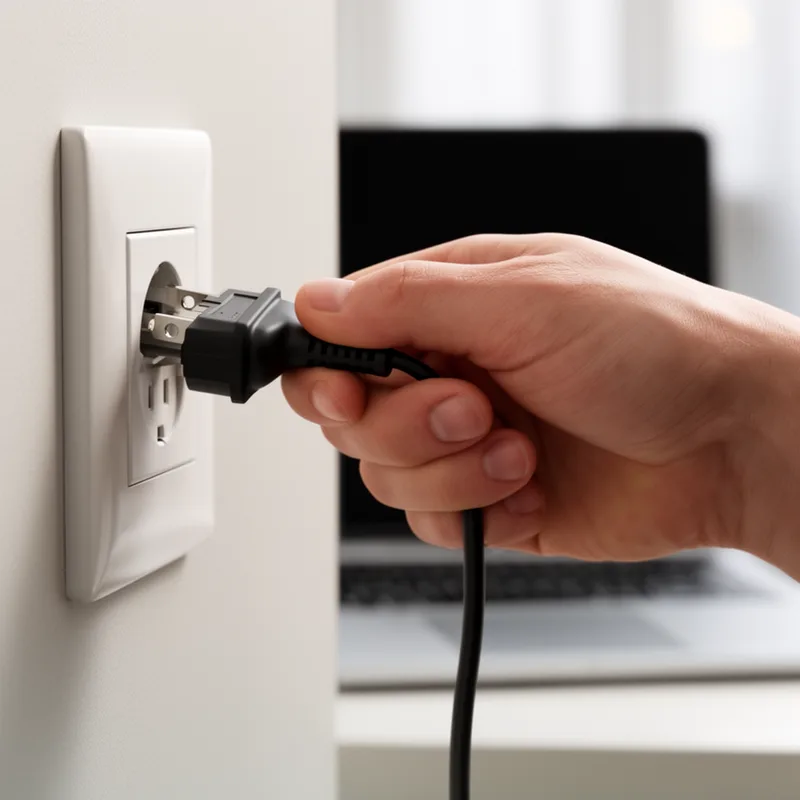
to plug out
- phrasal verb
- /plʌg aʊt/
- UK
- Please plug out your laptop before you leave the office.
Examples
-
She always remembers to plug out her phone charger at night.
-
Please plug out the toaster after use.
-
He quickly plugged out the television during the thunderstorm.
-
She plugged out the lamp before leaving.
-
He quickly plugged out the television during the thunderstorm.
-
Please plug out your laptop before you leave the office.
-
She always remembers to plug out her phone charger at night.
Synonyms

 161
3.5
161
3.5

To separate something so it is no longer joined, for example remove a cable or turn off power
 28
2.6
28
2.6
To take a plug out of a wall socket so an electric device stops getting power

Remove a device's plug from the socket so it has no power

To make equipment safe by turning off its power

To stop a machine part from getting power so it no longer moves
Antonyms

How Connected

Surface Forms
Morphology
The meaning 'to disconnect by removing the plug' is directly derivable from combining 'plug' (the electrical connector) with 'out' (movement away/removal) — the phrase literally means to pull the plug out of the socket. This particle+verb composition is a transparent, compositional pattern (akin to 'pull out' or 'take out'), so a B1 learner who knows the constituents can infer the meaning even though 'unplug' is the more common form.
Etymology
The verb plug out comes from the simple action of pulling the electrical plug out of a socket, like a hand removing it to stop the power. That's why it means 'to disconnect' an electrical device from its power.