
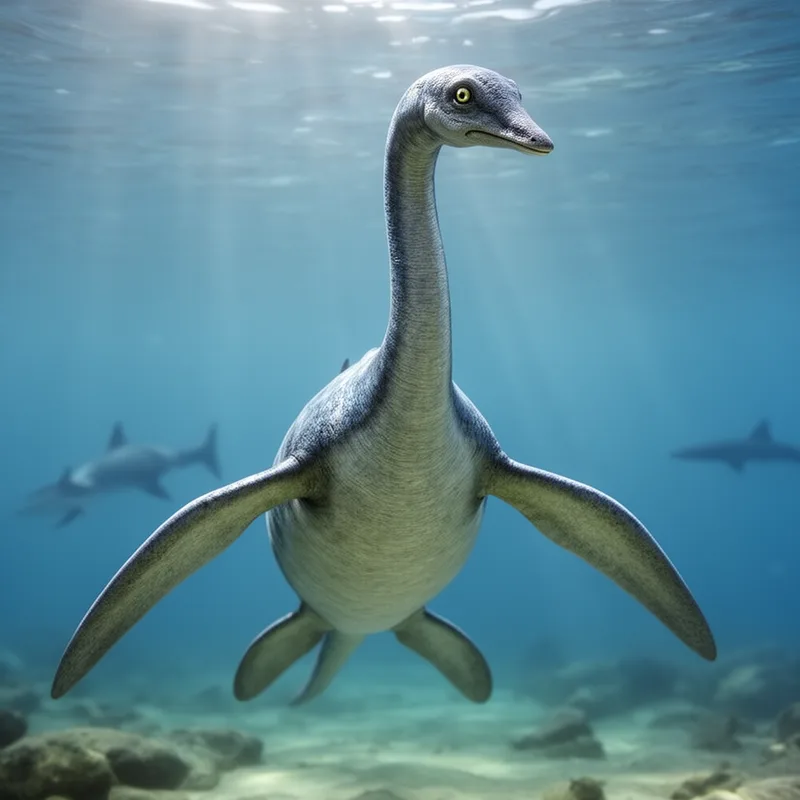
plesiosaur
 2
9.9

- noun
- /ˈplɛziəˌsɔr/
- In addition to the long-necked plesiosaurs, a short-necked variety, known as pliosaurs, plied the Mesozoic seas.
- long-necked plesiosaur
Examples
-
Anning's contribution to paleontology is perhaps best exemplified by her 1823 discovery of a complete, nine-foot-long plesiosaur, a strange sea animal with a tiny head atop an inordinately long neck and four paddles for swimming.
Academic text (1995) -
One of the most complete Plesiosaur skeletons ever found was Rhomaleosaurus.
-
Plesiosaur evolution is turning out to be rich and complex.
Academic text (1995) -
What are these long-necked Plesiosaurs called?
-
With their four strong paddles, Plesiosaurs soon become the new kings of the seas.
-
Marine reptiles' remains have been found on every continent, particularly those of Plesiosaurs.
-
During the Jurassic period, a new group of marine reptiles takes over, the Plesiosaurs.
-
Plesiosaurs lasted as long as the dinosaurs, until the end of the Cretaceous, 65 million years ago.
-
Until recently, relatively little work had been done on these animals' way of life, but paleontologists are starting to revise Conybeare's vivid picture of plesiosaur natural history.
Academic text (1995) -
The plesiosaur, with its small head and long neck, is a fascinating example of prehistoric marine life.
Synonyms


 1
9.9
A large sea animal with a small head, long neck, and paddle limbs that lived long ago
Surface Forms
Morphology
plesiosaur = plesio + saur
The word is built from Greek combining forms (plesio- + -saur) used in scientific names; these are not productive standalone English morphemes and the meaning is not derivable by an average B1 learner.
Etymology
The word plesiosaur comes from Greek parts plesio- meaning 'near' and -saur meaning 'lizard'. This 'near lizard' name helps you remember that a plesiosaur was a lizard-like sea reptile with a small head, long neck, and paddle-like limbs.