
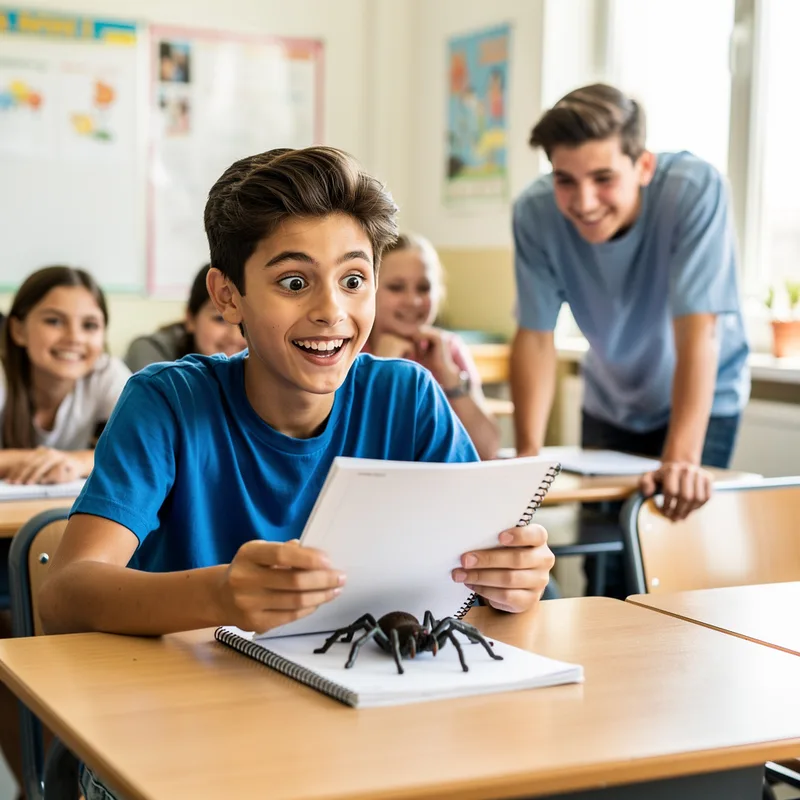
to play pranks
 4
3.1
4
3.1

- phrasal verb
- We strongly advise you not to play pranks on the police in the future.
- kids playing pranks
- always playing pranks
- play pranks on each other
Loading YouTube…
Watch on YouTubeWell, you both enjoy playing pranks on set.
- Well, you both enjoy playing pranks on set.
- And she played pranks on me on stage and like she was just heaven.
- So she starts to, like, be really destructive and she, like, starts playing pranks on people.
Examples
-
You know, playing pranks on Halloween is one thing.
-
My friends and I love to play pranks on each other for fun.
-
Well, you both enjoy playing pranks on set.
-
This one is always playing pranks on me.
-
Okay, did you ever play pranks on the kids in your charge?
-
Miles liked to play pranks.
Fiction book (2001) -
Unfortunately, my young nephew has played pranks like this in the past.
-
Playing pranks used to be fun.
-
Bart uses the radio to play pranks on others, including one where he tricks the town into thinking a little boy is stuck in a well.
Blog text (24) -
At the center of these carnivals are costumed revelers playing pranks in the streets.
Academic text (1998)
Synonyms
 40
8.4
40
8.4
To trick someone as a joke to make them feel foolish
 16
2.9
16
2.9
To play a trick on someone to make people laugh
 15
3.0
15
3.0
To make someone believe something that is not true as a joke
 6
2.8
6
2.8
To fool someone as a joke
 5
3.2
5
3.2
To trick someone in a friendly way to make them laugh
 2
4.5
2
4.5
To trick people into believing something false
How Mischievous

Surface Forms
Morphology
The meaning is directly and transparently derived from combining the verb 'play' (to engage in an activity) with 'prank' (a trick or practical joke); a learner who knows both words can infer 'to carry out tricks or practical jokes.' This compositional pattern (verb + noun indicating performing an action) is common across languages and follows standard English usage, so it should be immediately comprehensible to a B1 learner.
Etymology
Play pranks comes from the simple image of play as fun and pranks as small tricks. Imagine friends hiding a toy to surprise someone; that picture shows why it means 'to carry out tricks to surprise or amuse others'.