
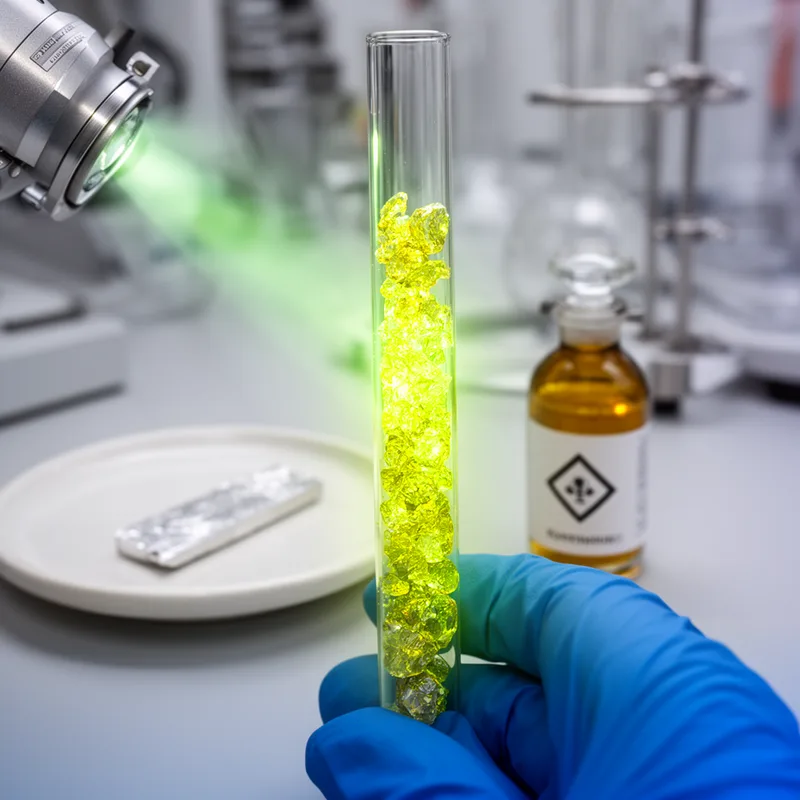
platinocyanide
- noun
- /plætɪnoʊˈsaɪənaɪd/
- Specialized
- When Roentgen began his experiments, it had already been noted that a screen painted with barium platinocyanide fluoresced if placed close to a Crookes tube that was equipped with a thin aluminum window, but the phenomenon was not observed through the heavier walls of glass tubes.
- barium platinocyanide
- platinocyanide crystals
Examples
-
Had he done so, he might have found from control experiments (exposing the plate to the screen in the absence of X-rays) that the barium platinocyanide crystals produced a general blackening of the film.
Academic text (1995) -
Röntgen similarly first saw the first glimmer from his barium platinocyanide screen out of the corner of his eye.
Academic text (1995) -
He used a fluorescent screen as his detector: George G. Stokes's barium platinocyanide crystals, adhering to a thin sheet of paper.
Academic text (1995) -
In the laboratory, the scientists carefully mixed platinum and cyanide ions to create a sample of platinocyanide for their experiments.
-
The vibrant colors emitted by the platinocyanide compounds amazed the chemistry students during the demonstration.
-
To test the new method of synthesis, the chemist needed a supply of platinocyanide for the reaction.
Surface Forms
Morphology
Etymology
Platinocyanide is made from platin-, from platinum, a precious metal whose name comes from Spanish platina meaning 'little silver', and cyanide, from cyan 'blue'. So, platinocyanide is a chemical that contains both platinum and cyanide parts.

