
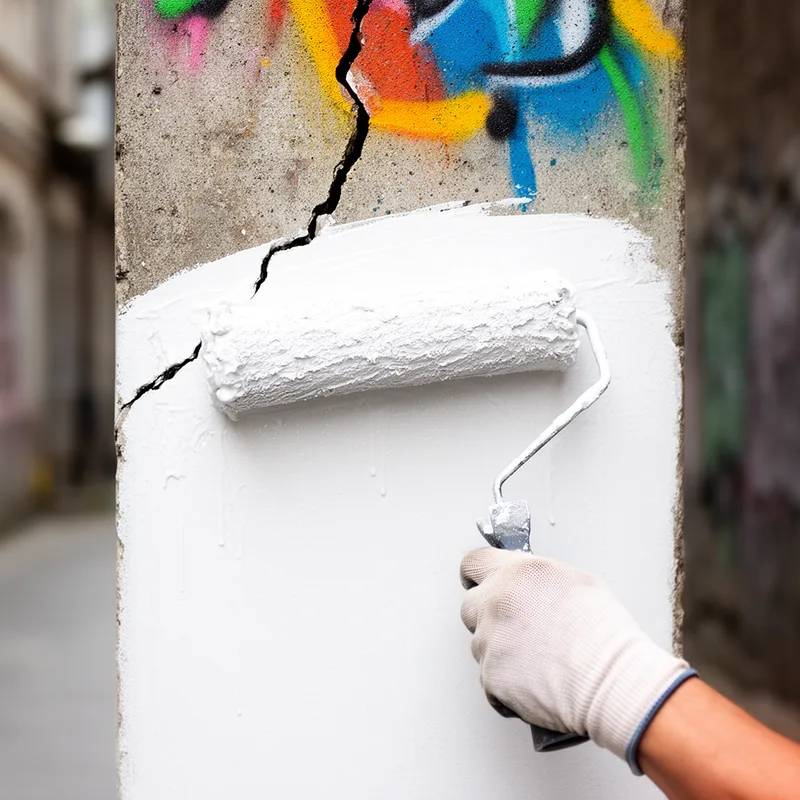
to plaster over
 1
4.5
1
4.5

- phrasal verb
- /ˈplæstər ˈoʊvər/
- But you kind of love them just because they're relics, even as you rip them out or plaster over them.
Loading YouTube…
Watch on YouTubeThe previous artists that have been it, we're going to get put as a one big piece just plastered over all of them.
- The previous artists that have been it, we're going to get put as a one big piece just plastered over all of them.
Examples
-
All we've done is put a plaster over the cracks.
Blog text (30) -
Following the renovations, they plastered over the uneven surfaces to create a smooth finish.
-
The entire structure was plastered over, which thereby provided a certain degree of watertightness.
Academic text (1995) -
The center of the town has older-style houses, some built with mud bricks, many of which are plastered over with cement, others left plain.
Academic text (2001) -
We also found that two holes had been dug into the walls and then plastered over; we think they were made to contain objects that were later removed.
Academic text (2006) -
Some are plastered over and painted in pastels, one or two faced with Spanish tiles, azulejos.
Fiction book (1991) -
These tombs are usually made of regular brick and mortar, then plastered over and whitewashed.
Blog text (25) -
There stood her dress form, armless, chastely plastered over with brown paper, though her own lines were visible, low-set and full-fleshed, a friendly shape.
Fiction book (1995) -
So it was in a state of personal and ontological crisis that I wandered across the ceiling to the location of an old pneumatic message tube, removed and plastered over some 50 years before.
Fiction book (1995) -
After repairing the wall, they decided to plaster over the cracks to improve its appearance.
Synonyms
 30
3.8
30
3.8
To cover a surface thickly or stick things all over it
 2
6.5
2
6.5
To cover a wall with plaster or cement to make it smooth and protect it


 1
6.3
1
6.3
To cover a wall or ceiling with hard plaster
Antonyms


How Thick

Surface Forms
Morphology
The sense is directly compositional: 'plaster' (to coat a surface) combined with 'over' (covering/above) yields the action of applying a coating to cover or hide imperfections. This verb+particle covering pattern is common and cross-linguistically transparent, so a B1 learner who knows both constituents would likely infer the meaning.
Etymology
Plaster over comes from the work of fixing walls: builders would spread plaster over cracks or bad spots to hide them and make the wall smooth. So it now means 'to hide or cover up problems'.