
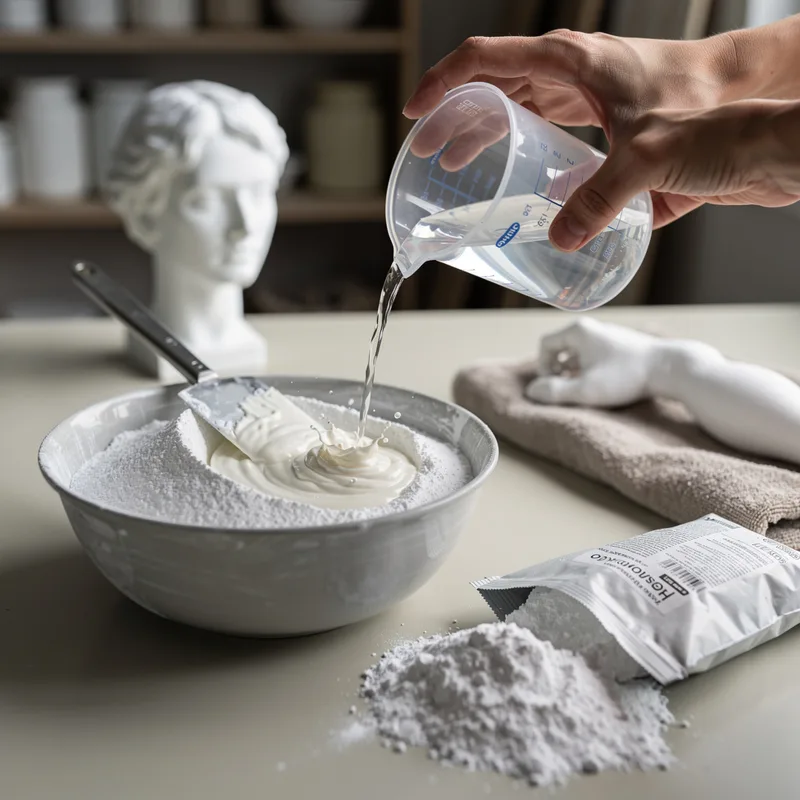
plaster of Paris
 1
4.1
1
4.1

- noun
- /ˈplæstər əv ˈpærɪs/
- Specialized
- The first piece of art that I made was made with plaster of Paris, and it was made in a rubber mould.
- made from plaster of Paris
Loading YouTube…
Watch on YouTubeAnd they, you know, they put that they do a little bit of light kind of plaster of Paris on them.
- And they, you know, they put that they do a little bit of light kind of plaster of Paris on them.
Examples
-
Foundations are built with concrete, not plaster of Paris!
Fiction book (2002) -
For her sculpture project, she used plaster of Paris to create detailed molds.
-
Two scale models were made of plaster of Paris.
Academic text (1993) -
A box of plaster of Paris.
Fiction book (1995) -
The knee was immobilized in a plaster-of-Paris cast for six weeks.
Academic text (2000) -
To treat spondylitis and scoliosis, for example, he designed a plaster-of-Paris body cast for straightening the spine.
Academic text (1994) -
These casts are made from plaster of Paris and are applied at weekly intervals for a 5- to 6-week course (Herzenberg, 2002) (Figure 4).
Academic text (2005) -
The nurse hands me a sterile dressing, and I wrap Dinh's fingers in loose layers of fluffy gauze followed by a light cast of plaster of Paris.
Fiction book (2000) -
The doctor applied a plaster of Paris cast to support the broken arm while it healed.
-
He mixed water with plaster of Paris to make a smooth paste for his art class.
Synonyms
 53
2.7
53
2.7
A mixture that hardens and makes walls or ceilings smooth
Surface Forms
Morphology
The phrase names a kind of plaster and is compositionally built from 'plaster' (a hardening gypsum mix) + 'of' (indicating origin/association) + 'Paris' (a place). This follows a common noun + of + place pattern found cross-linguistically, so a B1 learner who knows the constituents will readily infer it denotes a specific type/variety of plaster (even if they may not know the technical gypsum details).
Etymology
Plaster of Paris comes from the area around Paris, where people dug up a white mineral called gypsum and turned it into a fine powder. That powder, known as plaster, makes a quick-setting paste when mixed with water, so today the name means 'the hard white material used for molds, sculptures, and casts for broken limbs'.