

plant scientist


 1
4.0
1
4.0
- noun
- /plænt ˈsaɪəntɪst/
- Plant scientists are in particularly high demand given the scope and nature of the environmental problems we face.
- university plant scientist
- State University plant scientist
Examples
-
There, plant scientists have sought Kaper's expertise in devising vital satellite inoculants for seedlings.
Academic text (1996) -
The research conducted by the plant scientist led to significant advancements in sustainable agriculture.
-
A phenomenon, I might add, that has made you one of the most talked-about plant scientists in the country...
-
Our particular concern for this article is the capacity of universities to prepare plant scientists to address national needs for protecting biodiversity, especially in light of the complex global environmental challenges facing our society.
Academic text (2011) -
PlantingScience provides high school students who are carrying out self-designed scientific research projects with online mentoring and support from plant scientists.
Academic text (2007) -
Plant scientists first encountered the phenomenon, called systemic acquired resistance (SAR), in the 1930s.
Academic text (2003) -
Food-related emissions and the impacts of climate change on agriculture and the food system will affect the way that we cultivate and produce food, states Sonja Vermeulen, a plant scientist from the University of Copenhagen in Denmark.
Blog text (8) -
During her studies, the plant scientist discovered a new species of flower in the rainforest.
-
Many plant scientists are now focusing on genetically modifying crops to withstand climate change.
Synonyms
 ∞
2.1
∞
2.1
A person who studies science and does experiments to find new facts
 111
3.5
111
3.5
A scientist who studies living things and where and how they live
 22
4.1
22
4.1
A scientist who studies plants like trees and flowers
 18
4.8
18
4.8
A person who studies plants and animals in nature
 4
7.8
4
7.8
A person who grows and studies garden plants like flowers and vegetables
 2
8.7
2
8.7
A person who studies and advises farmers about soil and crops
 1
9.3
1
9.3
A scientist who studies how people in different cultures use plants for food and medicine
 1
9.5
1
9.5
A scientist who studies plant fossils from long ago
 1
8.6
1
8.6
A scientist who puts living things into groups by their features
 1
3.5
1
3.5
A person who studies living things and how they work
 1
3.7
1
3.7
A person who studies plants, animals, and where they live
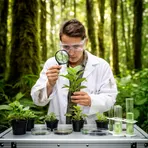
A scientist who studies plants

A scientist who studies trees and other plants that have wood
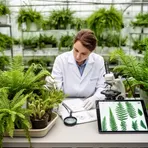
A person who studies ferns
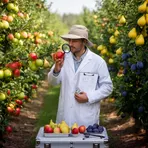
A person who studies and grows fruit trees

A scientist who studies the chemicals in plants

A person who grows and cares for trees and small bushes in parks, gardens, or towns
How Knowledgeable
1
4.0

- Specialized
4
7.8
150
1.0
81
1.0
Surface Forms
Morphology
The meaning 'a biologist who specializes in the study of plants' is directly and transparently built from 'plant' (a photosynthetic organism) + 'scientist' (someone engaged in scientific research), so a learner who knows both words can infer a scientist who works with plants. This is a regular noun-noun compositional pattern (equivalent to 'plant biologist' or 'botanist') and is cross-linguistically common, making it immediately comprehensible to B1 learners.
Etymology
Plant scientist joins plant, meaning the green living things, and scientist, meaning a person who studies nature. The name comes from the simple idea of someone who 'studies plants' in fields, greenhouses, or labs, so it directly means 'a biologist who studies plants'.