

planetary
 1
9.9
1
9.9

- noun
- /ˈplænɪˌtɛri/
- Astronomers realized that planetaries consist of multiple shells in which gas particles do not simply shoot outwards, but interact according to the complex laws of hydrodynamics.
- planetary nebula
- proto-planetary
- faint planetary
Examples
-
He found the few bright emission lines characteristic of a gas cloud in the spectra of many nebulae, including the planetaries and the great nebula in Orion.
Academic text (1990) -
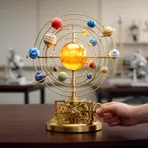
The musician created a beautiful planetary to mimic the orbits of the planets in our solar system.
-
Many planetaries contain jets that remain straight and regular along their extent.
Academic text (1996) -
These pulses create the shells we see in planetaries.
Academic text (1996) -
Planetaries are a record of stars' death throes, a means to look back in time by studying structures farther away from the center of the nebulae.
Academic text (1996) -
Yet most planetaries are not perfectly round; instead, they are bipolar (hourglass-shaped), elongated, or elliptical.
Academic text (1996) -
All mixing operations were conducted using a 25 L (845.35 fl. oz) capacity planetary-type laboratory mixer.
Academic text (2016) -
During the performance, the planetary resonated with melodies that represented each planet's unique movement.
-
She was fascinated by the sounds produced by the planetary, which conveyed the essence of celestial bodies.
Synonyms

 1
9.9
1
9.9
A machine that shows how the planets and their moons move around the Sun
Compounds

- Specialized
3
7.7
A glowing shell of gas thrown off by a dying star and lit by the star's strong light

- Specialized
1
7.4
A gear that turns around a central sun gear to change speed in a gearbox

- Specialized
A rule that describes how planets move around the Sun in oval paths

- Jargon
In astrology, one of twelve equal parts of the sky showing different areas of life

- Specialized
A machine with a fixed bowl and a moving arm that mixes dough and batter
Surface Forms
Etymology
Planetary as a noun comes from planet plus -ary, a part that means 'related to', so it names a device that copies the planets. Think of it as a moving 'model' of the solar system, which is why a planetary shows the planets' movement.