
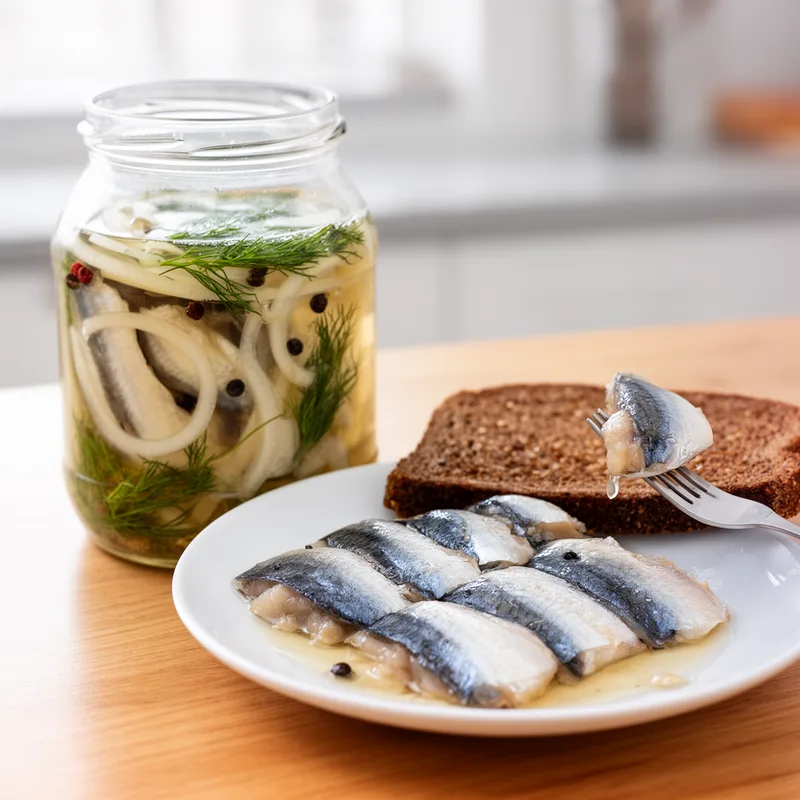
pickled herring
 3
3.1
3
3.1

- noun
- /ˈpɪkəld ˈhɛrɪŋ/
- At the buffet, I always look forward to the pickled herring served with onions and sour cream.
Loading YouTube…
Watch on YouTubeAnd so we're in the Google search page and we type pickled herring.
- And so we're in the Google search page and we type pickled herring.
Examples
-
Some crudo, sushi, cured salmon, smoked trout, pickled herring; any or all of it would be a fitting "lunch."
Blog text (20) -
ELLEN: How exactly am I supposed to make breakfast when there's nothing in the larder... but pickled herrings and marmalade?
-
You ever had pickled herring?
-
Could you please remember to bring the pickled herring to the casino tonight?
-
Pickled herrings for breakfast and marmalade for lunch.
-
Pickled herring, brown bread, soap—all the smells hanging around the shop like ghosts.
Fiction book (1993) -
Oh, and there chefs do wonderful prepared foods like tenderloin and fried chicken, and during the Jewish holidays, they have divine chopped chicken liver and pickled herring.
Blog text (29) -
Located far, far up in Northern Europe, Sweden conjures up images of pickled herring, meatballs in light-brown gravy, whipped potatoes, and red, tart lingonberries.
Blog text (34) -
Every holiday season, my family prepares traditional dishes, including pickled herring and potato salad.
-
He added pickled herring to his sandwich for an extra burst of flavor.
Surface Forms
Morphology
The meaning 'a herring preserved in vinegar/brine' is directly and transparently derived from combining 'pickled' (preserved in vinegar or brine) with 'herring' (the fish). This simple adjective+noun composition follows regular English semantics and is cross-linguistically common, so a B1 learner who knows both words would readily infer the MWE's meaning.
Etymology
Pickled herring comes from an old way to keep fish to eat later: people soaked the herring in salt or vinegar so it would not go bad. That's why the phrase means a herring 'preserved' in a sour or salty liquid and served as food.