
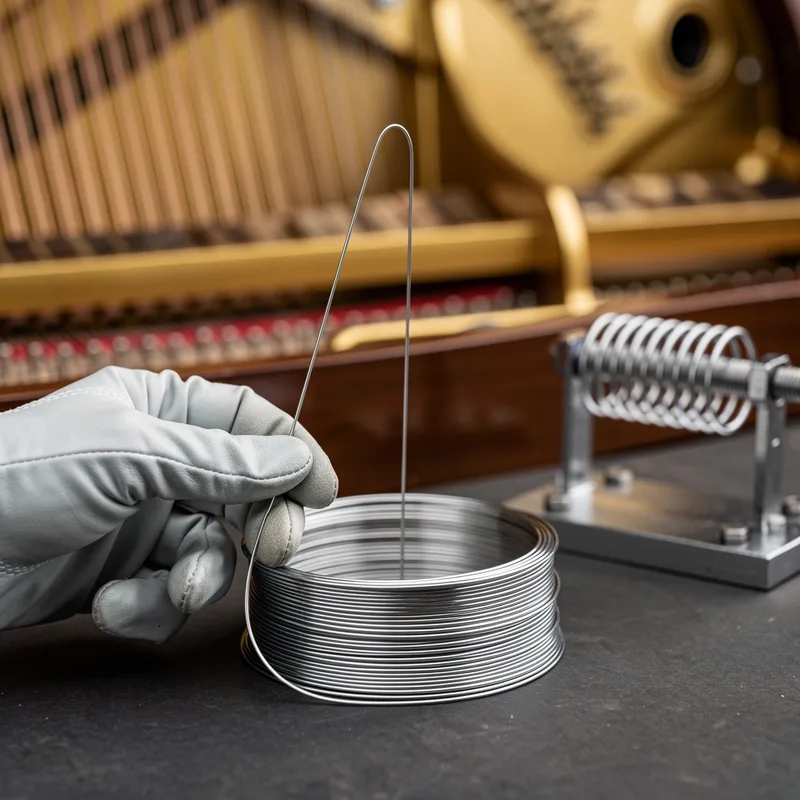
piano wire
 3
5.6
3
5.6

- noun
- /ˈpiːənoʊ waɪər/
- Specialized
- The artisan chose piano wire because it could withstand tension without stretching.
Loading YouTube…
Watch on YouTubeSo for objects, he went to the store that sold piano wire, and he strung piano wire from the ceiling to the floor of the room.
- So for objects, he went to the store that sold piano wire, and he strung piano wire from the ceiling to the floor of the room.
- You know, there's piano wire rod that can go up here and take the weight off Bunges.
Examples
-
The musician carefully replaced the broken string with a new piece of piano wire.
-
So for objects, he went to the store that sold piano wire, and he strung piano wire from the ceiling to the floor of the room.
-
Or a rusty piece of piano wire.
-
He is tangled in piano wire.
Fiction book (1992) -
To create the frame of the model, he used piano wire for its strength and flexibility.
Synonyms
 700
1.0
700
1.0
A thin metal strand used to carry electricity or to fasten things
 76
2.1
76
2.1
A thin, tight cord on a musical instrument or racket
How Thick
700
1.0

- Specialized
3
5.6
Surface Forms
Morphology
This is a straightforward noun–noun compound: 'piano' restricts the noun 'wire' to the wires used in a piano (i.e., piano strings). The meaning is literal and compositional, and such modifier+head compounds are cross-linguistically common, so a B1 learner who knows both words will readily infer it.
Etymology
Piano wire comes from the wires used as the 'strings' inside a piano, where each wire is a long, thin piece of steel stretched tight to make sound. So, piano wire now means a very strong, thin steel wire used in pianos and for other precise or strong jobs.