
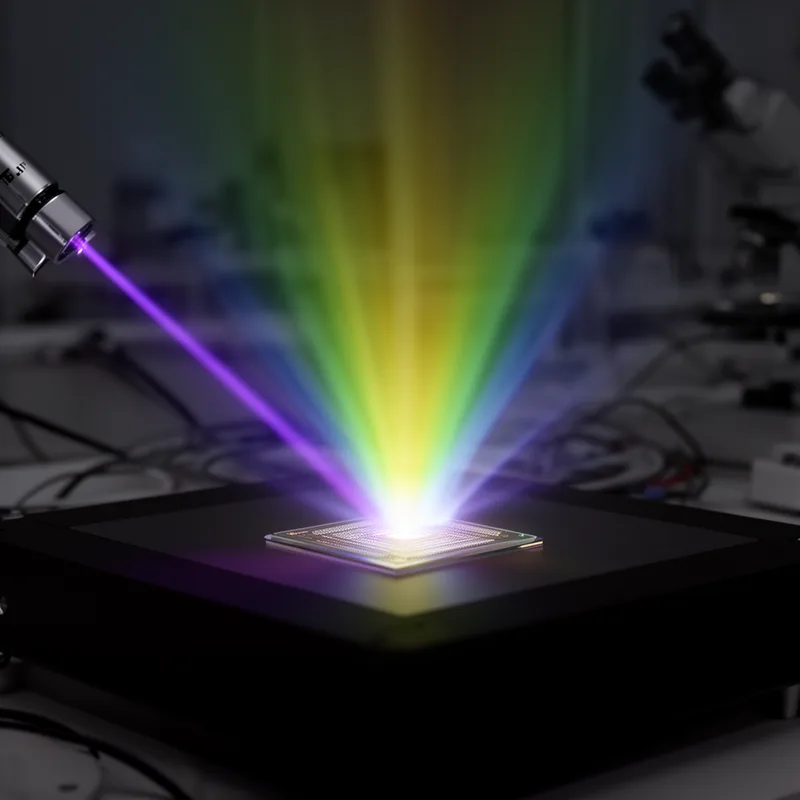
photoluminescence
- noun
- /ˌfoʊtoʊluːməˈnɛsəns/
- Specialized
- Understanding Photoluminescence.
- photoluminescence imaging
- photoluminescence spectra
Examples
-
Two years ago, two research collaborations reported photoluminescence characteristic of exciton emission that occurred in a circle some distance from where a laser had initially formed excitons.
Academic text (2004) -
As a result, the QD's photoluminescence spectrum changes.
Academic text (2002) -
The photoluminescence spectrum from a single
Academic text (2002) -
For photoluminescence imaging, a second set of samples was prepared as above.
Academic text (2018) -
Here, dark blue, green, and yellow correspond to low, medium, and high photoluminescence, respectively.
Academic text (2002) -
Also, while photoluminescence is an incoherent process, light scattering is fundamentally coherent.
Academic text (1994) -
The degradation in the minority carrier lifetimes under these laser-processed regions was studied using the photoluminescence (PL) imaging technique.
Academic text (2018) -
Using a dynamic photoluminescence (PL) imaging method proposed by Ramspeck et al., we were able to generate a spatially resolved minority lifetime mapping of our samples.
Academic text (2018) -
In the laboratory, the team measured the photoluminescence of the material after exposing it to light.
-
The researchers observed that the photoluminescence increased when the substance was heated.
Synonyms

 5
6.7
5
6.7

Light appears when something takes in other light, like minerals or jellyfish
 2
7.0
2
7.0
Light that a material gives off without heat
Surface Forms
Morphology
photoluminescence = luminescence (semi-transparent) = photo + lumin + escence
The target is formed by adding the scientific prefix photo- to luminescence, but the term remains specialized and not fully predictable for many learners.
Etymology
Photoluminescence comes from photo- which means 'light', as in photograph, and from luminescence based on lumen, which also means 'light' and appears in luminous. It describes a material that 'glows' after it absorbs light, so the word literally says 'light shining from light'.