
photodisintegration
- noun
- /ˌfoʊtoʊˌdɪsɪnˈtɪɡreɪʃən/
- Specialized
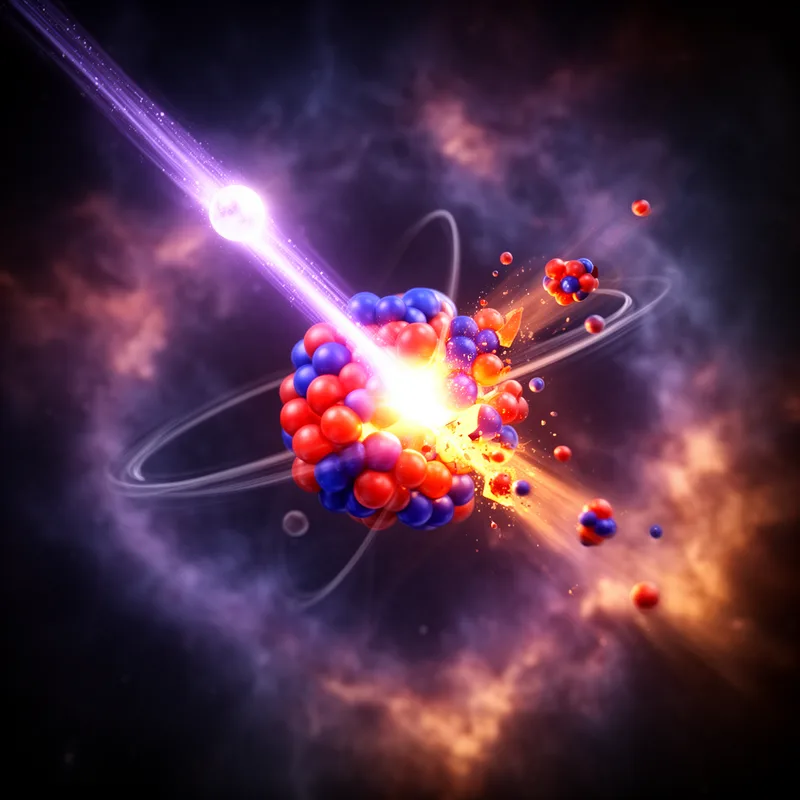
- In nuclear physics, photodisintegration occurs when a deuteron absorbs a photon and splits into smaller nuclear components.
- photodisintegration of the deuteron
Examples
-
The first experiments at the Brookhaven and Frascati hadron-beam facilities revisited the classical problem of deuteron photodisintegration by measuring the azimuthal asymmetry.
Academic text (2005) -
With Peierls, he laid the foundations for understanding the structure of the deuteron, neutron-proton and proton-proton scattering, and the photodisintegration of the deuteron.
Academic text (2005) -
He also studied the effects of exchange and tensor forces between nucleons on many particles and processes, including the magnetic moments and quadrupole moments of small nuclei, nuclear pair emission, deuteron photodisintegration, and particles of higher spin.
Academic text (1995) -
Researchers observed photodisintegration during their experiments with high-energy photon beams on target nuclei.
-
The phenomenon of photodisintegration helps scientists understand the interactions between photons and atomic nuclei.
Surface Forms
Morphology
photodisintegration = disintegration (semi-transparent) = photo + dis + integrate + ion
The target word is formed by adding the productive combining form photo- to the already transparent noun disintegration.
Etymology
Photodisintegration starts with photo- meaning 'light', as in photograph, and it includes disintegrate meaning 'break into parts'. So photodisintegration literally means 'light' making something break apart, for example when an atomic nucleus splits after it absorbs a tiny particle of light.

