

phase angle
- noun
- /feɪz ˈæŋɡəl/
- Specialized
- The device was very fast (able to give results in less than 5 seconds), had frequency options ranging from 1 Hz to 30 kHz, and was able to detect the phase angle between 0 and 180 degrees.
Examples
-
Astronomers quantify lunar phases by defining the phase angle of the Moon to be the angle between the Sun and Earth as viewed from the Moon.
Academic text (2004) -
And indeed it is, and it's phase angle shown below is an odd function of frequency.
-
The relative phase angles for the four cases are shown.
Academic text (1998) -
Also, power flowing over an AC line is proportional to the sine of the phase angle between the power source and the receiving end.
Blog text (5) -
The phase angle of the signal determines its position within the waveform cycle.
-
When analyzing AC circuits, the phase angle plays a crucial role in understanding power delivery.
-
In optics, the phase angle affects how light waves interfere with each other.
Synonyms
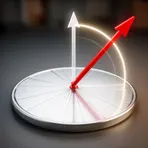
The direction a line or object points, measured as an angle
Surface Forms
Morphology
The term is directly compositional: 'phase' denotes a position within a cycle and 'angle' is a measure in degrees/radians, so 'phase angle' straightforwardly denotes the angular measure of a point's phase. Although technical, this logic is transparent and cross-linguistically common, so a B1 learner who knows both constituents can reasonably infer the meaning.
Etymology
Phase angle comes from the image of a wheel or clock hand: phase is the point in a repeating wave and angle is how far the hand has turned from a fixed mark. So a 'phase angle' tells you the point in the wave's cycle by showing that turn as an angle.

