
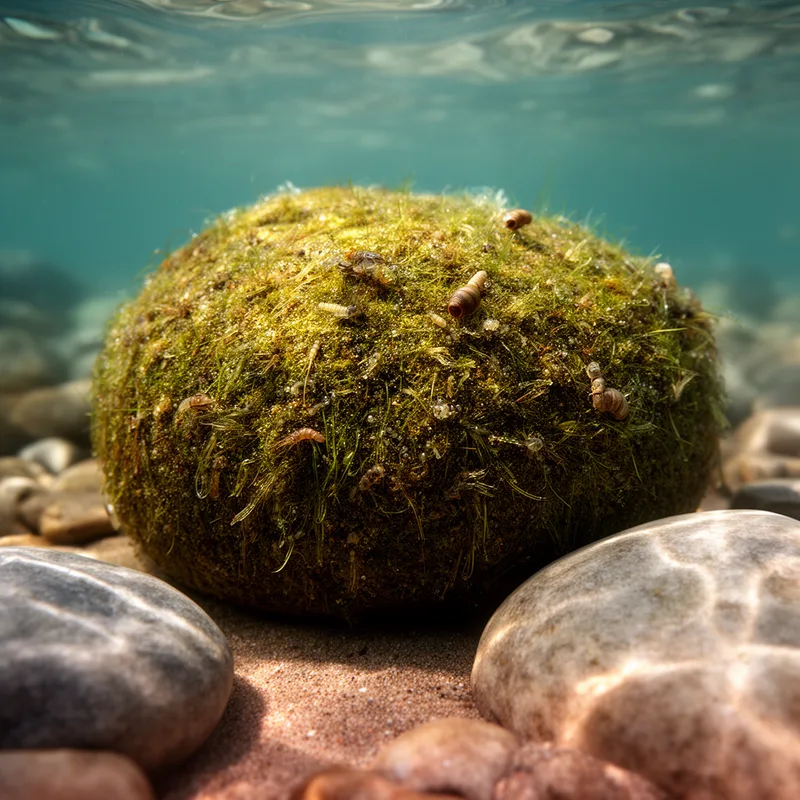
periphyton
- noun
- /ˌpɛrəˈfaɪtən/
- Specialized
- The scientists studied the periphyton that grew on submerged plants to understand its role in the ecosystem.
- periphyton growth
Examples
-
In the pond, the periphyton covered the rocks, providing a habitat for small aquatic organisms.
-
Indeed, when wall productivity is expressed per unit of wall surface area, periphyton growth rate on tank walls is a hyperbolic function of tank radius (Figure 7b).
Academic text (2003) -
(b) Productivity of the wall periphyton expressed per unit of wall area in the same mesocosms.
Academic text (2003) -
Some scientists are concerned that similar errors may exist with data on other assemblages (specifically, fish and periphyton), but this is as yet untested.
Academic text (2006) -
A review of the literature revealed that periphyton growth is cleaned from tank walls in only a small percentage of mesocosm studies (Figure 2b).
Academic text (2003) -
Simulations revealed that under our experimental conditions, artifacts associated with periphyton growth on mesocosm walls could be reduced to acceptable levels by cleaning the walls twice each week and using tanks with a radius of 2 m or greater.
Academic text (2003) -
(a) Relative contribution of wall periphyton to the total gross primary productivity (GPP), in milligrams of oxygen per square meter per hour, within mesocosms of different dimensions.
Academic text (2003) -
Results from this series of experiments were also generally consistent with our expectation that the relative contribution of wall periphyton to total system productivity and associated nutrient uptake would decrease with increasing radius (Chen et al. 1997, 2000).
Academic text (2003) -
Robinson and Uehlinger (2008) observed distinct response times of moss, periphyton, and invertebrates to the high flows in the River Spl, which led to differences in cumulative effects from a series of 15 floods on these different parts of the aquatic community.
Academic text (2011) -
These uprooted trees leave holes in the ground that fill with water (Ulanova 2000) and are initially free of predators and competitors; they also receive more sunlight, which increases the water temperature and periphyton productivity, to the benefit of herbivorous tadpoles (Skelly et al. 2005).
Academic text (2009)
Synonyms
A group of algae and tiny water organisms that grow on plants and rocks underwater
Surface Forms
Morphology
periphyton = phyton (semi-transparent) = peri + phyton
Formed from the Greek combining form 'phyton' ('plant') with prefix 'peri-' ('around/on'); the components are technical combining forms common in scientific vocabulary and may not be immediately recognizable to average learners.
Etymology
Periphyton comes from Greek parts peri- meaning 'around' and phyton meaning 'plant'. Think of it as 'plants around' a rock or leaf: periphyton are the small algae and tiny organisms that grow attached to underwater surfaces, which is why the word names that community.

