

perihelion
 2
9.9
2
9.9

- noun
- /ˌpɛrɪˈhiːliən/
- Specialized
- For example, here are the times of the passages of the Earth at perihelion in some years.
- perihelion passage
- perihelion distance
- time of perihelion
Examples
-
The diagram at right shows the behavior around perihelion.
Academic text (1992) -
lt will reach its perihelion and impact the Far East first.
-
This comet reaches its perihelion every 4200 years.
-
The outbursts occur within a few years of each perihelion of this parent comet.
Academic text (1994) -
Comet Tempel-Tuttle returned to perihelion in 1998, leading to spectacular showers in 1998 and 1999.
Academic text (2001) -
If you find a comet near the predicted time of perihelion passage, you can construct an ephemeris from the orbital elements.
Academic text (1996) -
The combination (2 + 2 Gamma - Beta) / 3 modulates the advance of the perihelion of planets such as Mercury.
Academic text (1999) -
Graph: Brightness variations of Comet Halley near perihelion.
Academic text (1992) -
The Moon is at perigee, 6:19 p.m. PST. JANUARY EVENTS: 3 Full Moon is at 5:57 a.m. PST. Earth is at perihelion, noon PST.
Academic text (2006) -
The Earth is at perihelion on January 4th, making it the closest point to the Sun during its orbit.
Synonyms

The point in an object's orbit when it is closest to the body it goes around
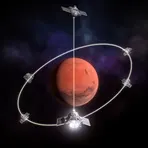
A place in an orbit where an object is closest to the planet or star it goes around
Antonyms
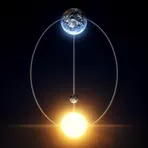
- Specialized
1
9.9
The point in a planet's or comet's orbit when it is farthest from the sun
Surface Forms
Morphology
perihelion = peri + helion
The elements 'peri-' and 'helio/helion' are Greek combining forms not familiar to an average B1 learner, so the meaning 'nearest to the sun' cannot be reliably derived from the parts.
Etymology
Perihelion comes from Greek parts peri- 'around', as in perimeter, and helios 'sun'. So it literally means 'around the sun' and names the point in a planet's or comet's orbit when it is closest to the sun.