
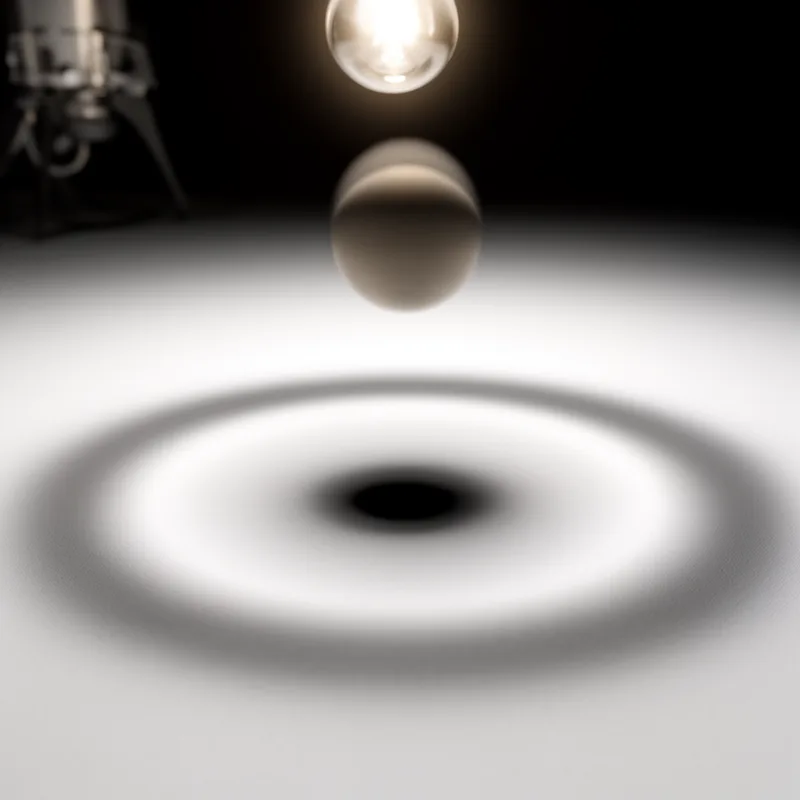
penumbra
 3
9.9
3
9.9

- noun
- /pəˈnʌmbrə/
- Specialized
- During a solar eclipse, the penumbra is the area where only part of the sun is obscured by the moon.
- penumbra of the shadow
Loading YouTube…
Watch on YouTubeThese evoke the penumbras that flutter around Whitman's subjects.
- These evoke the penumbras that flutter around Whitman's subjects.
- And the surrounding areas, the penumbra, which is where part of the sun is, is covered.
- Darkness was introduced and now there's even more room to be removed In cross hatched penumbra clipped moon a stripe of light under the door.
Examples
-
The brightest star is 4.8-magnitude SAO 76532, Omega Tauri, which will be occulted in the penumbra in eastern North America.
Academic text (1993) -
And the surrounding areas, the penumbra, which is where part of the sun is, is covered.
-
The diameter of the penumbra is about twice that of the Earth.
Academic text (1991) -
At night the penumbra between light and dark weakens.
-
If the umbra is a total eclipse, the penumbra is a partial one; it is paene, almost a total shadow.
Academic text (2017) -
The umbra is surrounded by a penumbra (plural: penumbrae), which is not as dark.
Academic text (1991) -
As the moon moves into the penumbra, it creates a partial shadow on the Earth's surface.
-
In an eclipse, the penumbra is the region that experiences a slight dimming of light but is not completely dark.
Synonyms


Antonyms

How Dark
4
2.5

- Specialized
1
9.9
102
1.0
- Specialized
3
9.9
9
1.0
Surface Forms
Etymology
The word penumbra comes from the Latin parts paene 'almost' and umbra 'shadow', so it literally means 'almost-shadow'. That's why a penumbra is the soft, partial shadow you see at the edge of a dark shadow, such as the faint shading during an eclipse.