

pea crab
- noun
- /piː kræb/
- The pea crab often lives inside the shells of oysters along the coast.
Examples
-
Restaurants added a few pea crabs to each stew so the customers would know they were made with Chincoteague oysters; the crabs are orange when cooked and float around the edges of a bowl of stew.
Academic text (1996) -
The shuckers also saved some pea crabs to eat at home in oyster stews or fritters (Anderson13).
Academic text (1996) -
The salinities of most Maryland waters are too low for pea crabs.
Academic text (1996) -
Pea crabs are not abundant in Connecticut oysters.
Academic text (1996) -
PHOTO (BLACK & WHITE): Figure 4. The pea crab, Pinnotheres ostreum, from Williams (1965).
Academic text (1996) -
The salinity in Hampton Roads was high enough for pea crabs, and they invaded the planted oysters.
Academic text (1996) -
In the 1920s, pea crabs sold for $4-6/gallon (Anonymous, 1920b).
Academic text (1996) -
As the oysters were being opened, the shuckers set aside the pea crabs and gave them to the workers in the houses' packing rooms; the workers sold them to the Fulton Market in New York.
Academic text (1996) -
The companies saved the pea crabs to sell; the Ballard Fish and Oyster Company produced 1-2 gallons of pea crabs per day.
Academic text (1996) -
The companies saved the pea crabs to sell; the Ballard Fish and Oyster Company produced 1-2 gallons of pea crabs per day.
Academic text (1996)
Synonyms
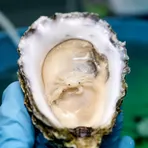
A tiny soft crab that lives inside oysters

A small soft crab that lives inside the shell of an oyster

Small crabs that live inside the shells of oysters or clams
Surface Forms
Morphology
The modifier 'pea' signals very small size, so a B1 learner who knows 'pea' and 'crab' would plausibly infer that this refers to a very small crab. However, the precise biological sense (a commensal that lives inside bivalve mantles) is not predictable from the parts, so the expression is only partially transparent.
Etymology
Pea crab is named for the animal's tiny size and hidden home: these little crabs are about the size of a pea and often live inside oysters or mussels like a pea in a pod. So the name means 'a very small crab that lives inside shells'.

