
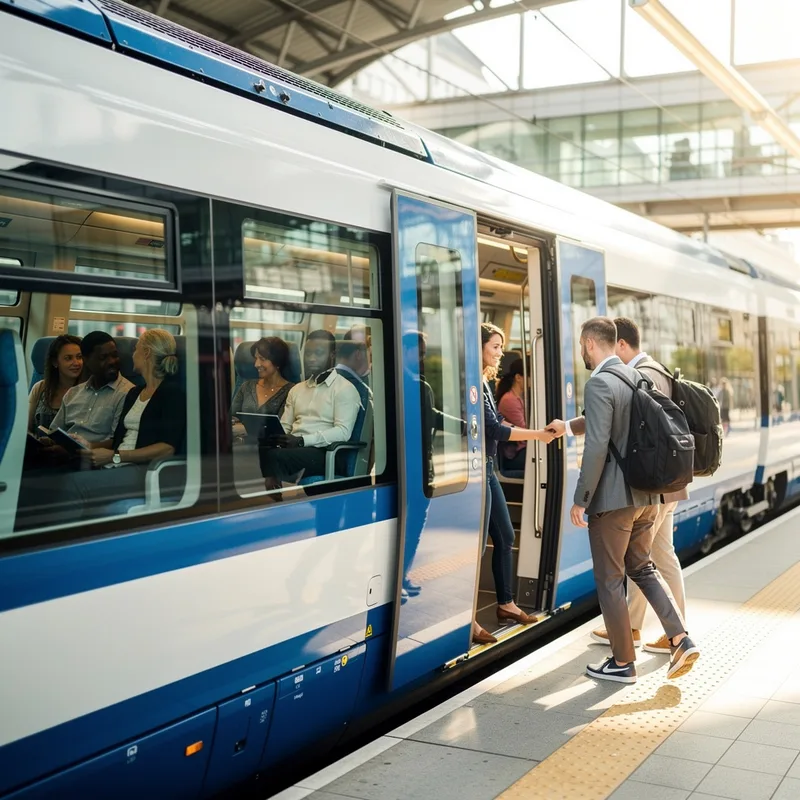
passenger train
 8
1.5
8
1.5

- noun
- /ˈpæsɪndʒər treɪn/
- Amtrak also laid out plans to resume some passenger train service in the Northeast on Wednesday.
- Eurostar passenger train
Examples
-
Bewildered rural faces coming down off the passenger train.
Fiction book (1993) -
The company manufactured luxury passenger train cars with a revolutionary sleeping berth arrangement.
Blog text (7) -
Listen to me, we can find out how fast passenger trains went back then.
-
Just one passenger train per day on the Mexican line?
-
We were also running against No. 36, an eastbound passenger train.
Fiction book (1999) -
On the outer shade was the picture of a passenger train rolling through forests and mountains.
Fiction book (1997) -
I've wished for a return to an efficient passenger train system for many years.
Blog text (24) -
Hundreds of migrants continue to arrive three times a week on the passenger train from impoverished Maranhao.
Academic text (1992) -
“It was an ordinary passenger train, “full of travelers on their way home or on holiday.”
-
The passenger train arrived at the station just in time for the festival.
Synonyms
 10
2.5
10
2.5
A train that carries people who travel regularly between home and work or school in a city
 7
2.1
7
2.1
A train that runs under a city to carry people
 5
2.8
5
2.8
A very fast passenger train that runs on special tracks like those in Japan
 1
1.8
1
1.8
A long line of connected cars that runs on tracks and carries people or goods
 1
4.5
1
4.5
A train that carries people and their cars

A train that takes people to a port to catch a ship
How Big

Surface Forms
Morphology
The meaning is directly and transparently derived from combining 'passenger' (a person traveling) with 'train' (a series of carriages on rails) to indicate a train that carries people rather than goods. This is a straightforward compositional noun phrase with close equivalents in many languages, so a B1 learner who knows both constituents will readily understand it.
Etymology
Passenger train comes from a simple idea when trains began: some trains carried people and some carried things. The word passenger means a person who travels and train is the vehicle, so together it became 'a train for people'.