
passed ball
 1
7.0
1
7.0

- noun
- /pæst bɔl/
- Jargon
- Williams scooted to third, and LaRue now had three passed balls on the day—and it was still just the first inning.
- passed ball on a pitch
Examples
-
Pagan led off the fifth with a homer to give us a 2-1 lead that held until a sixth-inning passed ball tied it up.
Blog text (2) -
There was one more wild pitch, but no more passed balls.
Blog text (13) -
Got a base on a passed ball.
Blog text (2) -
At least this time it wasn't a passed ball.
Blog text (13) -
Two pitches after the walk, a knuckler got away from LaRue for a passed ball.
Blog text (13) -
A passed ball advanced both runners, and a 3-1 pitch in the dirt put Austin Kearns on.
Blog text (18) -
Sure enough, it didn't take long for that to happen: two pitches to be exact, and he was on second thanks to a Jason LaRue passed ball.
Blog text (13) -
When the Mets were putting the team together, Casey was asked, "How will you start putting a team together?" He responded, "Well, you need a catcher, because without a catcher, you will get a lot of passed balls."
Blog text (1) -
Fortunately for LaRue, Fernandez soon picked off Spivey, so for a few minutes LaRue wouldn't have to worry about any passed balls.
Blog text (13) -
Lindor came home on a passed ball by Sanchez as Ramirez took second.
Surface Forms
Morphology
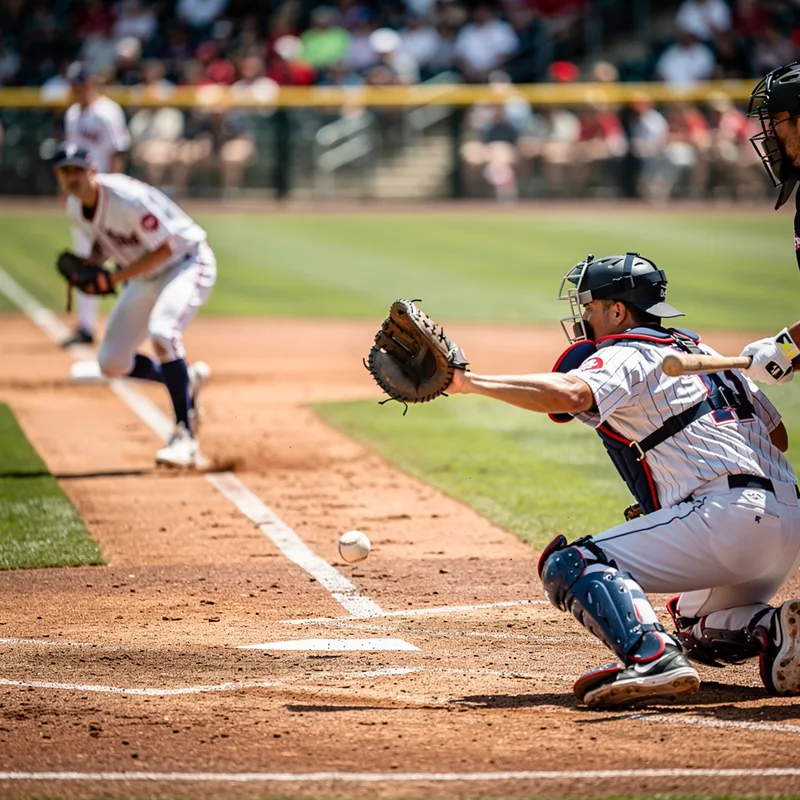
This is a sport-specific technical term whose meaning (a pitch the catcher should have caught but missed, allowing a runner to advance) is not directly derivable from the literal meanings of 'pass(ed)' and 'ball.' A B1 learner who knows the constituent words would likely misinterpret it (e.g. a ball that was passed) or be uncertain, since the rule-based baseball sense is idiomatic and culturally specific rather than compositional.
Etymology
The term passed ball comes from the simple image of a passed ball — the catcher fails to catch a pitch and the ball goes by, letting a runner 'advance' to the next base. That's why a passed ball means a pitch the catcher should have caught but did not, allowing a base runner to move up.