
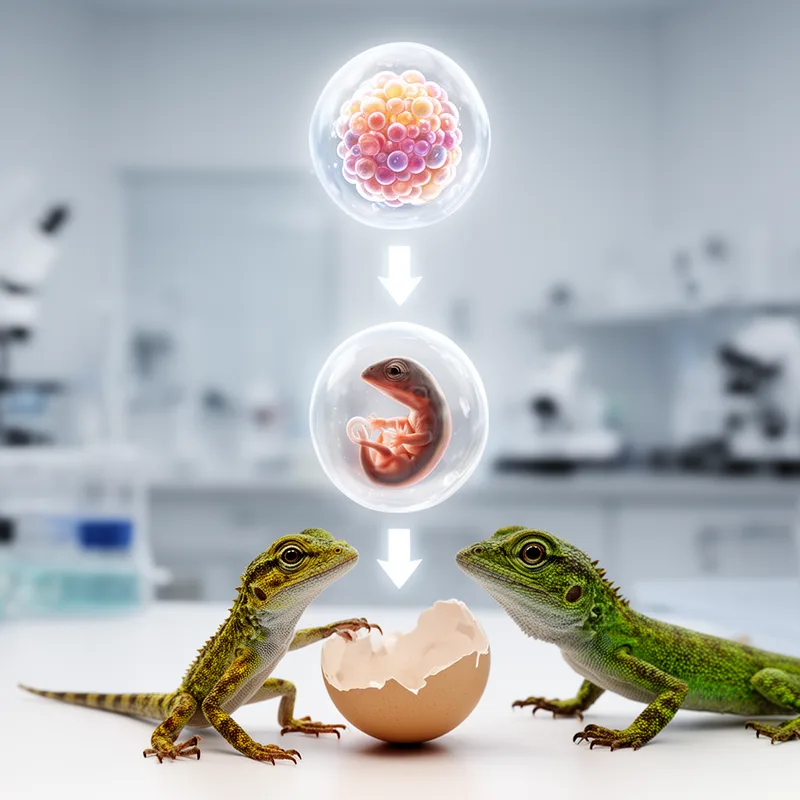
parthenogeny
- noun
- /ˌpɑrθəˈnoʊdʒəni/
- Specialized
- Some scientists are exploring the possibility of parthenogeny in mammalian cells.
Examples
-
Did you know that parthenogeny occurs in some species of bees?
-
The lizard population exhibited parthenogeny, with all offspring being female.
-
If parthenogeny could occur in humans, it would revolutionize reproductive technology.
-
The parthenogeny of certain lizards allows them to reproduce without males.
-
In some species of bees, parthenogeny occurs when an egg develops into a new bee without fertilization.
-
The process of parthenogeny allows certain plants to reproduce asexually, producing seeds that grow into identical copies.
-
Researchers observed parthenogeny in a type of lizard, where the females produced offspring without mating.
Synonyms
 1
9.9
1
9.9

An egg grows into a new animal or plant without being fertilized
Surface Forms
Morphology
parthenogeny = geny (opaque) = partheno + geny
The prefix 'partheno-' is not a standalone English word and requires specific etymological knowledge.
Etymology
Parthenogeny comes from Greek parts partheno- 'virgin' and -geny 'birth' or 'origin', the same idea you see in generate and generation. So, parthenogeny literally means a 'virgin birth'—an egg becomes a new animal without being fertilized.