
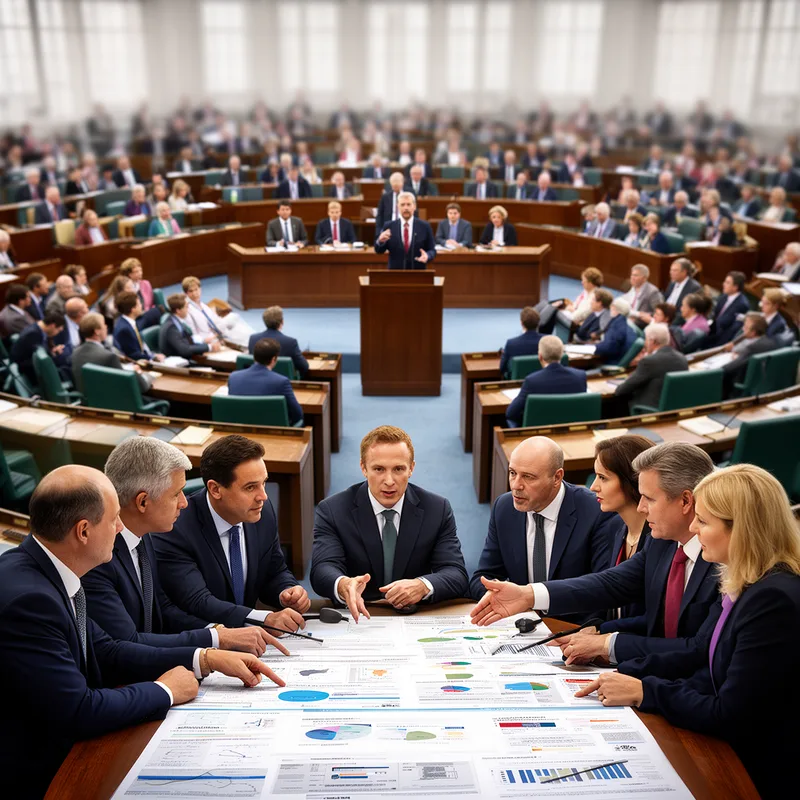
parliamentary-cabinet system
- noun
- Specialized
- The United Kingdom operates under a parliamentary-cabinet system in which the Prime Minister and Cabinet shape governmental policy.
Examples
-
In a parliamentary-cabinet system, the Cabinet's unity is crucial to the government's ability to pass legislation.
-
Many democracies adopted the parliamentary-cabinet system to ensure collective decision-making by executive leaders.
-
The parliamentary-cabinet system is common in many democracies.
-
Many countries adopt a parliamentary-cabinet system to ensure accountability.
-
In a parliamentary-cabinet system, the Prime Minister relies on the Cabinet to formulate and implement government policies.
-
During debates, members of the Cabinet in a parliamentary-cabinet system must present a united front to effectively govern.
-
Countries with a parliamentary-cabinet system allow the Cabinet to work closely with lawmakers to develop new legislations.
Synonyms

 3
4.2
3
4.2

A system where parliament chooses and controls the government


 1
7.7
1
7.7
A system of government where parliament chooses and controls the government leaders

A system where elected representatives make and run the government
Surface Forms
Morphology
parliamentary-cabinet + system
The components 'parliamentary' (relating to a parliament), 'cabinet' (the group of government ministers) and 'system' (a set of arrangements) transparently signal a political arrangement involving parliament and cabinet, so a B1 learner who knows the parts can infer the general idea. However, the specific institutional nuance that the Cabinet collectively determines government policy and its relation to legislation is specialized and not fully predictable from the words alone, so full comprehension may require some prior exposure.
Etymology
Parliamentary-cabinet system comes from two simple pictures: parliamentary means the leaders come from parliament, and cabinet was the name for a small group of ministers who met together in a private room to decide policy. So the phrase means 'a government where the Cabinet makes decisions together and answers to parliament'.