
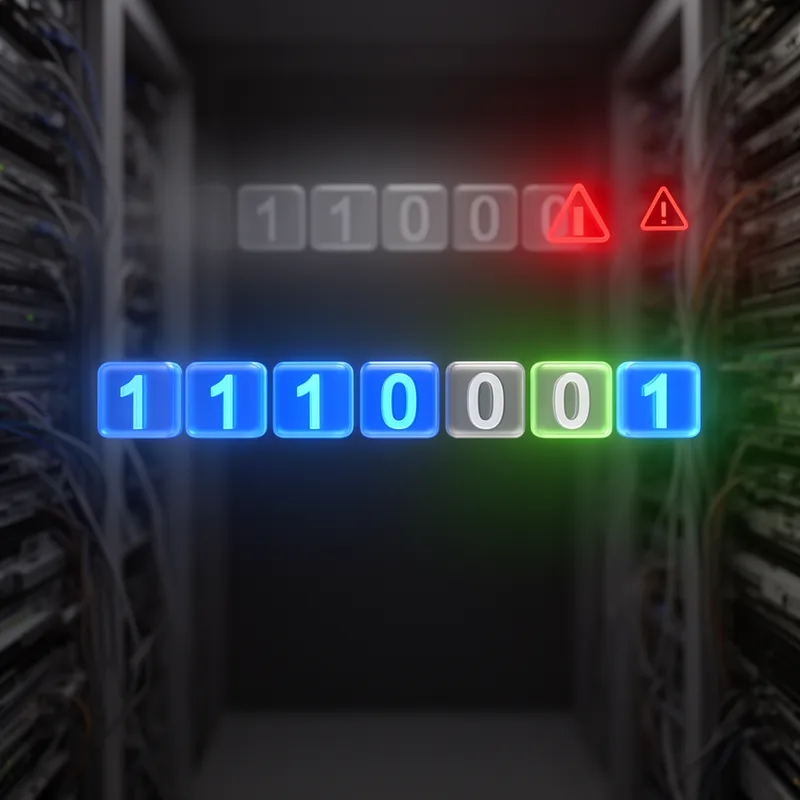
parity bit
- noun
- /ˈpærɪti bɪt/
- Specialized
- The serializer is checked by computing parity serially on the data leaving the shift register; at the end of each character, this is compared with a parity bit on the incoming parallel data.
Loading YouTube…
Watch on YouTubeThat's the message that these parity bits are there to check out and make sure it's OK.
- That's the message that these parity bits are there to check out and make sure it's OK.
Examples
-
In addition to the eight data bits and the parity bit, a clock is sent in each direction.
Academic text (1997) -
During address mode, a 9-bit address consisting of eight address bits and one parity bit is shifted into the address register, which selects the target for the following set pulse or shift gate in data mode.
Academic text (1997) -
And this is second parity bit sequence.
-
This extra bit was set to a zero or a one, using the value that made the total count of ones, including the parity bit itself, odd.
Fiction book (2002) -
That's the message that these parity bits are there to check out and make sure it's OK.
-
And still if any single bit gets flipped, then a unique combination of these three parity bits will be will be wrong.
-
It's a linear constraint relating the parity bit and the data bits.
-
The cache directory entry consists of the 20-bit real page number, a valid bit, and parity bits.
Academic text (1994) -
Another powerful method was tacking an extra bit—what a human programmer would call a parity bit—onto all important data.
Fiction book (2002) -
A parity bit is added to the data to ensure error detection during transmission.
Synonyms

An extra binary digit added to data to find errors in transmission or storage
How Reliable
- Specialized

- Specialized


 1
6.8
1
6.8
- Specialized
- Specialized
Surface Forms
Morphology
This is a straightforward noun–noun compound: 'parity' names the even/odd property and 'bit' names a binary digit, so a B1 learner who knows both constituents can infer that it is the bit indicating parity. Although the concept is technical, the composition is fully transparent and directly describes its function (a bit used for parity/error checking).
Etymology
Parity bit comes from the idea of adding one extra small bit like a tiny light at the end of a row so the total number of 'on' lights is even or odd. If one light flips, the total number changes, so the extra parity bit helps spot an 'error' and 'check' the data.