

parallelepipedon
- noun
- /ˌpærəˈlɛləˌpɪpɪdɒn/
- Specialized
- The crystal had the shape of a perfect parallelepipedon, with all faces forming parallelograms.
Examples
-
In geometry class, we learned how to calculate the volume of a parallelepipedon using its base dimensions.
-
Renaissance artists sometimes used a parallelepipedon as a model for drawing objects in perspective.
-
In geometry class, we learned how to calculate the volume of a parallelepipedon.
-
A parallelepipedon is a solid with six faces.
-
The parallelepipedon has six faces.
-
The crystal was cut into a perfect parallelepipedon, showcasing six identical parallelogram faces.
-
To visualize three-dimensional shapes, we used a parallelepipedon model during the art presentation.
Synonyms
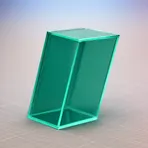
A three-dimensional solid with six faces that are parallelograms like slanted rectangles
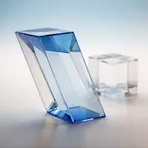
A solid shape with six flat faces that are parallelograms like a slanted box

A solid like a box but with slanted sides
Surface Forms
Morphology
parallelepipedon = parallelepiped (semi-transparent) = parallel + epipedon + on
The form is clearly derived from the standard English technical term 'parallelepiped' with an additional Greek-derived ending '-on' that does not change the core meaning.
Etymology
Parallelepipedon comes from Greek parts parallel and epipedon ('flat surface'). Think of it as the three-dimensional version of a parallelogram, which is why every face of a parallelepipedon is a parallelogram.

