

parallel interface


 1
5.7
1
5.7
- noun
- /ˈpærəˌlɛl ˈɪntərˌfeɪs/
- Archaic
 :
interfaz paralela
:
interfaz paralela
- She bought a new parallel interface cable to link her printer and laptop for faster data transfer.
Examples
-
Most transponders will support a parallel interface, although a few require a serial interface.
Blog text (27) -
But why do I have to talk about diodes, resistors, parallel interface?
-
Serial links offer many advantages over traditional parallel interfaces:
Academic text (1996) -
There is no need to provide a separate interface for each disk drive, as required by a multidrop parallel interface.
Academic text (1996) -
Parallel interfaces, where you might hook a printer cable into a computer.
Fiction book (1993) -
The recorded data are downloaded into a microcomputer through a parallel interface for data processing, analysis, and display.
Academic text (1995) -
The cost of a blind encoder runs from under $200 (parallel interface) to just under $600 (serial interface).
Blog text (27) -
It has a USB and parallel interface for Windows 98, Windows 200, and the Macintosh.
Academic text (2001) -
SSA has many advantages over existing parallel interfaces such as the Small Computer Systems Interface (SCSI-2).
Academic text (1996) -
A printer connects to the computer using a parallel interface, allowing it to receive multiple bits of data at once.
Synonyms
 1
4.3
1
4.3
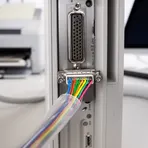
A socket on a computer that connects devices like printers and sends data across many wires
Surface Forms
Morphology
The noun phrase is compositionally built from 'parallel' (simultaneous/multiple operations) and 'interface' (a connection between devices), so a learner who knows both words can infer it denotes an interface that transmits data in parallel across multiple channels. This follows standard, cross-linguistically common compositional patterns rather than an idiomatic shift, making the meaning predictable to B1 learners.
Etymology
Parallel interface comes from the image of several wires running side by side: parallel means 'side by side' and interface means 'a connection' between devices. So a parallel interface sends many bits, small pieces of data, 'at the same time' along separate wires to a printer or other device, which is why it can move data faster than a single line.