
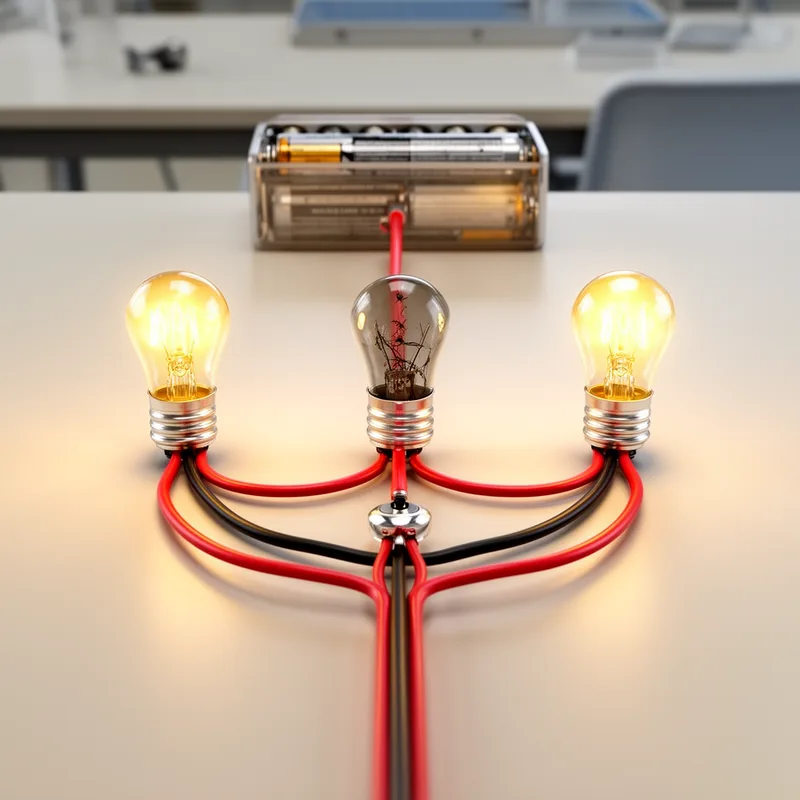
parallel circuit


 1
4.3
1
4.3
- noun
- /ˈpærəˌlɛl ˈsɜrkɪt/
- Specialized
 :
circuito paralelo
:
circuito paralelo
- When connecting multiple lights, it's best to use a parallel circuit so that if one bulb burns out, the others remain lit.
- simple or parallel circuit
- series and parallel circuits
Examples
-
One could design a parallel circuit to do the same thing as a series circuit; the voltage and amps are identical.
Blog text (31) -
Is the voltage the same in a parallel circuit?
Academic text (2008) -
Students may struggle with concepts such as the differences between series and parallel circuits and how they can be used.
Academic text (2013) -
This requires the students to explain their design decisions in terms of such concepts as simple and parallel circuits, voltage, and current.
Academic text (2008) -
In a parallel circuit, the total current is divided among the different branches.
-
In a parallel circuit, each device receives the same voltage, allowing them to operate independently.
Synonyms
An electric path where current splits into more than one branch and then joins again
How Extensive
17
2.8

- Specialized
1
4.3
- Specialized
1
4.0
47
3.6
Surface Forms
Morphology
The meaning is directly compositional: 'parallel' signals side-by-side or multiple simultaneous paths and 'circuit' is a route for electric current, so a learner can infer a circuit with more than one path for current. This technical naming is transparent and follows a cross-linguistic logic, making the overall concept accessible to a B1 learner who knows the two constituents.
Etymology
Parallel circuit comes from the image of the word parallel, meaning side-by-side, and the circuit, a loop for electricity. Electricity flows down two or more side-by-side paths and then joins again, so each device can work 'independently' and one can stop without turning off the others.