
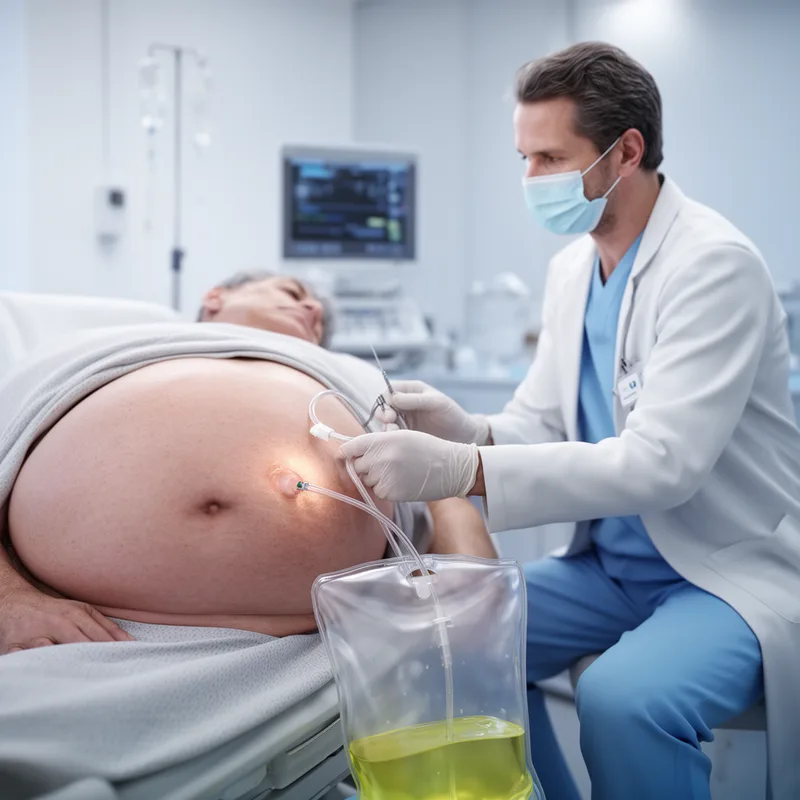
paracentesis


 1
9.4
- noun
- /ˌpærəˈsɛnˌtiːsɪs/
- Specialized
- During the paracentesis, the doctor carefully inserted a needle to remove excess fluid from the patient's abdomen.
- abdominal paracentesis
- therapeutic paracentesis
- large-volume paracentesis
Examples
-
After the paracentesis, the patient felt immediate relief as the pressure in their abdomen decreased.
-
Removal of less than 5 liters of fluid does not appear to have hemodynamic or hormonal consequences; post-paracentesis colloid infusion does not appear to be necessary.
Academic text (2007) -
The risk of developing a large hematoma after abdominal paracentesis is only 1%.
Academic text (2007) -
No complications were encountered after paracentesis of the anterior chamber.
Academic text (2018) -
Repeated paracentesis with intravenous albumin is probably the method of choice for the treatment of episodes of large ascites in these patients.
Academic text (2003) -
Another well-known precipitating factor of HRS is large-volume paracentesis without plasma expansion.
Academic text (2003) -
The collection of all samples was performed using standard sterile procedures, and AH samples were obtained via anterior chamber paracentesis using a 30-gauge needle.
Academic text (2018) -
The nurse prepared for the paracentesis by ensuring all necessary sterile equipment was readily available.
Synonyms

To remove fluid from the belly with a needle

A medical test that removes fluid from the belly to check for illness
Surface Forms
Morphology
paracentesis = para + centesis
This is a learned medical term built on Greek-derived material, but the components are not transparent to an average B1 learner and the meaning cannot be reliably inferred from the parts.
Etymology
The word paracentesis comes from Greek parts para- meaning 'beside' and -centesis meaning 'puncture' or 'to prick'. So a paracentesis is literally a medical 'puncture beside' the belly to draw out fluid with a needle, which explains its modern meaning.