
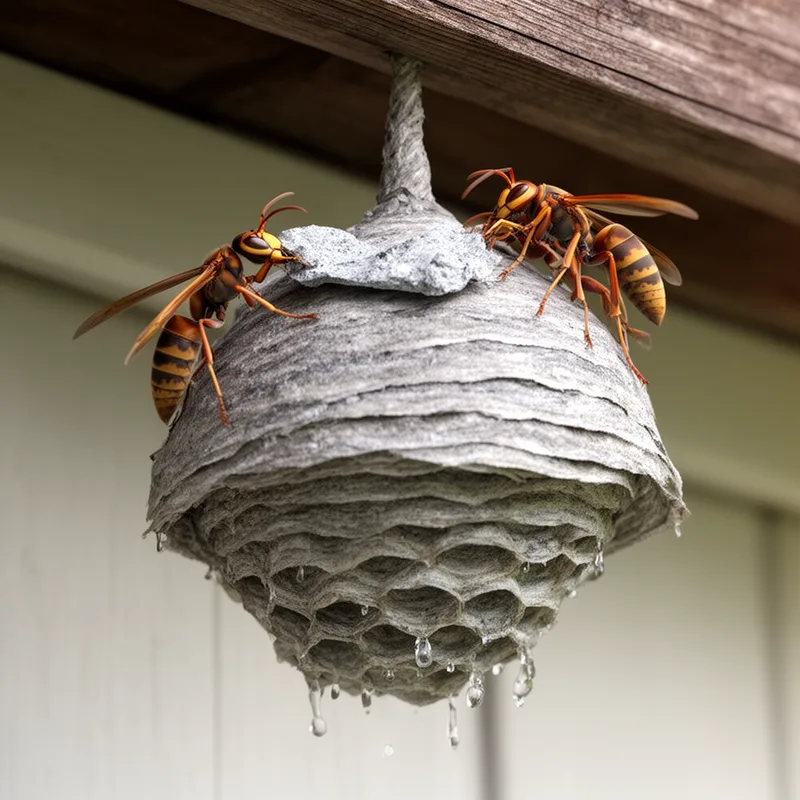
paper wasp
- noun
- /ˈpeɪpər wɑsp/
- If paper wasp behavior is any indicator, Kern Reeve of Cornell University thinks the answer is "yes."
Examples
-
"If the evolutionary forces are right, the descendants of today's paper wasps could be very similar to bees (a model we already know works quite well).
Blog text (3) -
Often, two female paper wasps will cofound a nest without killing each other.
Academic text (1996) -
And then you look at like, you know, the average paper wasp, not so smart.
-
Paper wasps, by contrast, learn recognition odors from their nest, which serves as a rich repository of their nestmates' phenotypes (Gamboa et al. 1986).
Academic text (1997) -
In a series of field experiments, Reeve and Nonacs (1997) provided strong support for this prediction by manipulating the value of nestmates (i.e., by reducing the size of the future worker force) in colonies of paper wasps.
Academic text (1999) -
The paper wasp collects plant fibers to create its unique papery nest high in the trees.
-
You can often find a paper wasp building its nest under the eaves of houses during the summer.
-
A paper wasp can be identified by its slender body and distinctive black and yellow markings.
Synonyms
 45
1.0
45
1.0

A flying insect like a bee with a narrow waist and a sting, often yellow and black
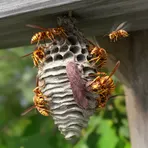
A group of social wasps that make paper-like nests
How Large

Surface Forms
Morphology
The compound is a straightforward noun+noun composition where 'paper' describes a salient property of the wasp (it makes papery nests). This descriptive, compositional relation is predictable and found cross-linguistically, so a B1 learner who knows 'paper' and 'wasp' will readily infer the meaning.
Etymology
Paper wasp is named for the thin, paper-like nest the wasp builds by chewing plant fibers and mixing them with its spit. That's why the name paper wasp simply describes a wasp that makes a nest that looks like 'paper'.