
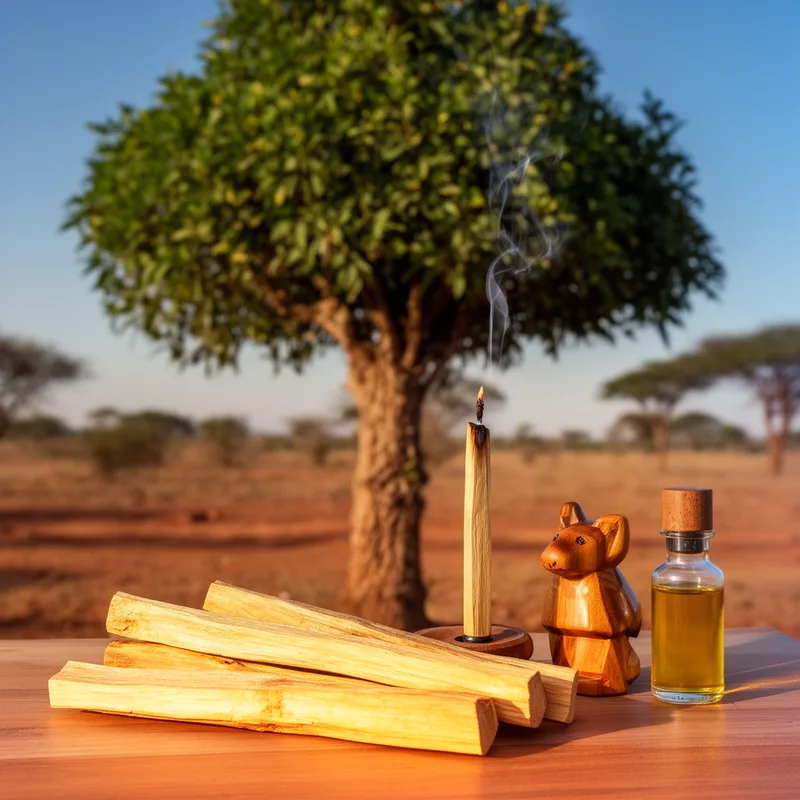
palo santo
- noun
- /ˈpɑːloʊ ˈsæntoʊ/
- The palo santo tree is known for its aromatic wood, which many people use for burning incense.
Examples
-
She lit some palo santo to cleanse the room and create a calming atmosphere.
-
Traditional medicine often incorporates palo santo oil for its soothing properties.
-
Biting ants in their thousands and tens of thousands hide beneath the shiny leaves of the palo santo or holy tree.
Fiction book (1991)
Synonyms
A South American tree from Argentina and Paraguay with fragrant wood used for incense
A group of South American trees, some called palo santo, whose wood smells sweet and is used for incense
Surface Forms
Morphology
palo + santo
Assuming the learner knows 'palo' (Spanish/loanword meaning 'stick' or 'wood') and 'santo' ('holy'), the compound literally reads as 'holy wood' so its sense as a fragrant/resinous wood or tree used for incense is directly derivable from the parts. Although it denotes a specific South American species and is a loanword, the meaning is compositional and cross-linguistically transparent, so a learner who knows the constituents will understand the basic sense.
Etymology
Palo santo comes from Spanish words palo ('stick' or 'wood') and santo ('holy'), meaning 'holy wood'. People in South America burned this fragrant wood in ceremonies to clean spaces and calm people, so today palo santo is known as a soothing incense.

