
pair production
- noun
- /pɛr prəˈdʌkʃən/
- Specialized
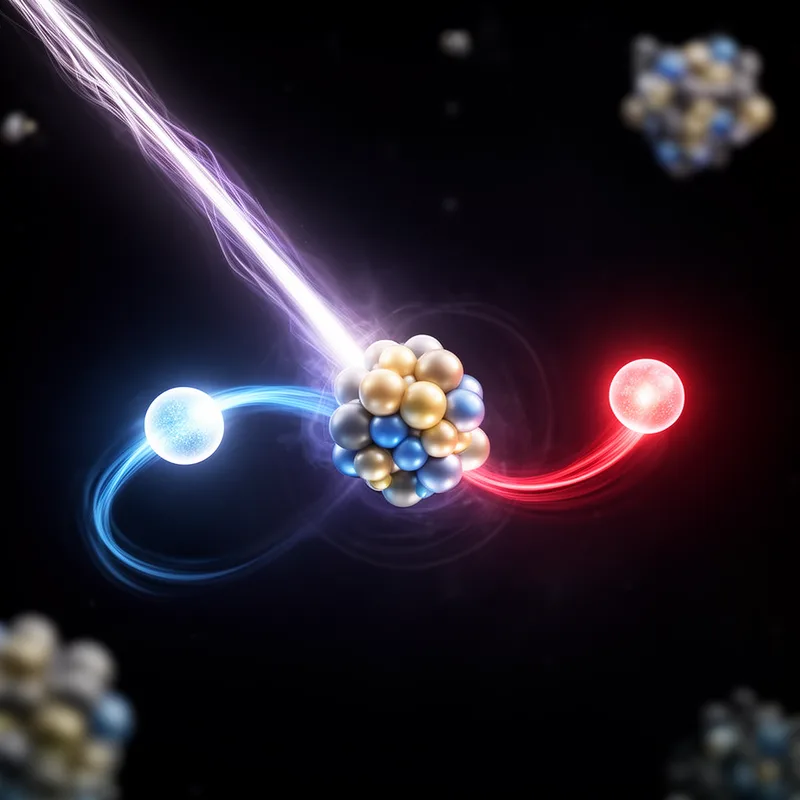
- When photons interact at high energies, the result can be pair production, creating matter from pure energy.
Examples
-
And in addition, pair production happens when a photon interacts with either the electron cloud or the nucleus there.
-
In high-energy physics, pair production occurs when a photon collides with a nucleus, converting energy into an electron and a positron.
-
There's going to be a pair production part which goes up with higher energies.
-
After hole theory was formulated, his calculations of cross sections for pair production and bremsstrahlung became classics.
Academic text (2005) -
Current theories of charge conservation and pair production, however, insist that for every piece of ordinary matter created in the Big Bang, there must be an equal and opposite amount of antimatter.
Academic text (2005) -
Moving away from the simplest configurations, Fig. 3 displays the results for electron-positron pair production.
Academic text (2018) -
This could conceivably happen in high-energy particle collisions or quantum-mechanical pair production.
Academic text (1996) -
The electrical discharge can spread within the cloud because of gamma-ray diffusion, pair production, and Compton scattering.
Academic text (2006) -
The Bethe-Heitler calculation of photon production (called by its German name, "bremsstrahlung") and pair production was the most important achievement of QED in the 1930s.
Academic text (2005) -
The interaction of these ultrarelativistic energy ions in gold foils illuminated, at extraordinarily high-collision energy, atomic physics aspects such as ion charge state change and electron-positron pair production.
Academic text (2002)
Synonyms
A process where a high-energy photon turns into an electron and a positron near an atomic nucleus

When a high energy light particle turns into an electron and a positron near an atomic nucleus
Surface Forms
Morphology
pair + production
The phrase is compositionally built from 'pair' (two items) + 'production' (creation), so a learner can infer the general idea of 'creation/formation of a pair'. However, the precise technical sense (a high-energy photon converting into an electron and a positron) is domain-specific and would not be predictable to an average B1 learner from the constituents alone.
Etymology
Pair production comes from a simple picture: the word pair means 'two' and production means 'making'. It describes how a single high-energy particle of light can turn into a pair of tiny particles, one negative and one positive, when it meets an atom, so the name explains the process today.

