

pair formation
- noun
- Specialized
- When a high-energy photon passes near a nucleus, pair formation can occur, resulting in an electron and a positron.
Examples
-
During pair formation, energy is converted into mass.
-
The phenomenon of pair formation provides evidence for the existence of antimatter.
-
Researchers observed pair formation as part of their experiments with gamma radiation.
-
The pair formation process is crucial in particle physics.
-
Researchers observed pair formation while studying gamma rays in their laboratory experiments.
-
The phenomenon of pair formation demonstrates how energy can create matter in particle interactions.
-
In particle physics, pair formation occurs when a gamma-ray photon interacts with a nucleus to create an electron and a positron.
Synonyms
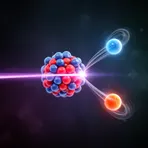
A process where a high-energy photon turns into an electron and a positron near an atomic nucleus
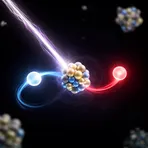
A very energetic light particle changes into an electron and a positron near a nucleus
Surface Forms
Morphology
At a general level a B1 learner who knows 'pair' and 'formation' can infer 'the formation of a pair' — i.e. the process of creating two matching items — so the phrase is partially compositional. However, the specific technical sense (a gamma photon converting into an electron and a positron near a nucleus) is domain-specific and not predictable from the constituents alone, so it is not fully transparent.
Etymology
Pair formation comes from a simple image: a single particle of light turning into a matching pair. In physics, a very energetic particle of light can change into two opposite charges — an 'electron' and a 'positron' — when it passes near the centre of an atom, so formation here means the making of that pair.

