
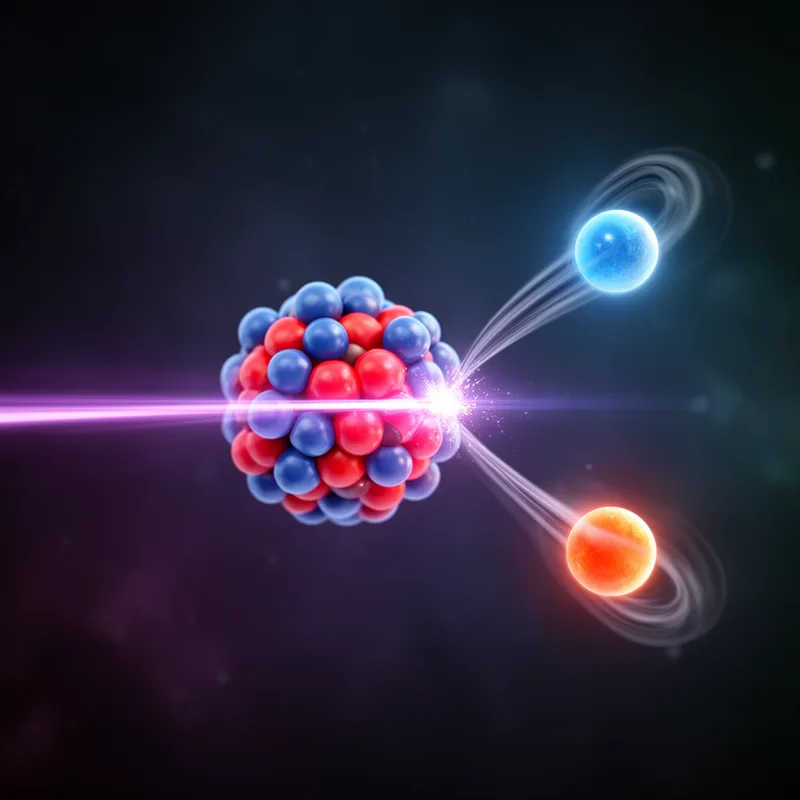
pair creation
- noun
- /pɛr kreɪˈeɪʃən/
- Specialized
- The phenomenon of pair creation is significant in understanding particle interactions in electromagnetic fields.
Examples
-
In high-energy physics, pair creation occurs when a gamma-ray photon interacts with a nucleus, producing an electron and a positron.
-
* Pure electromagnetic cross sections—for processes like Compton scattering and electron-positron pair creation—are much larger than those involving hadrons.
Academic text (2005) -
During experiments, scientists observed pair creation as gamma rays passed near atomic nuclei, confirming their theoretical predictions.
Synonyms

When a high energy light particle turns into an electron and a positron near an atomic nucleus
A very energetic light particle changes into an electron and a positron near a nucleus
Surface Forms
Morphology
The phrase literally means 'creation of a pair', so a B1 learner who knows 'pair' and 'creation' can infer a general sense of making two matching items. However, the specific technical meaning involving a photon producing an electron–positron pair in physics is domain-specific and not predictable from the constituents alone, so full comprehension requires extra knowledge.
Etymology
The term pair creation comes from the simple image of one very energetic light particle turning into two particles, an electron and a positively charged partner called a positron. The words pair and creation show that one thing is being made as a 'pair' of particles, so the name means the process where energy becomes two particles.

