
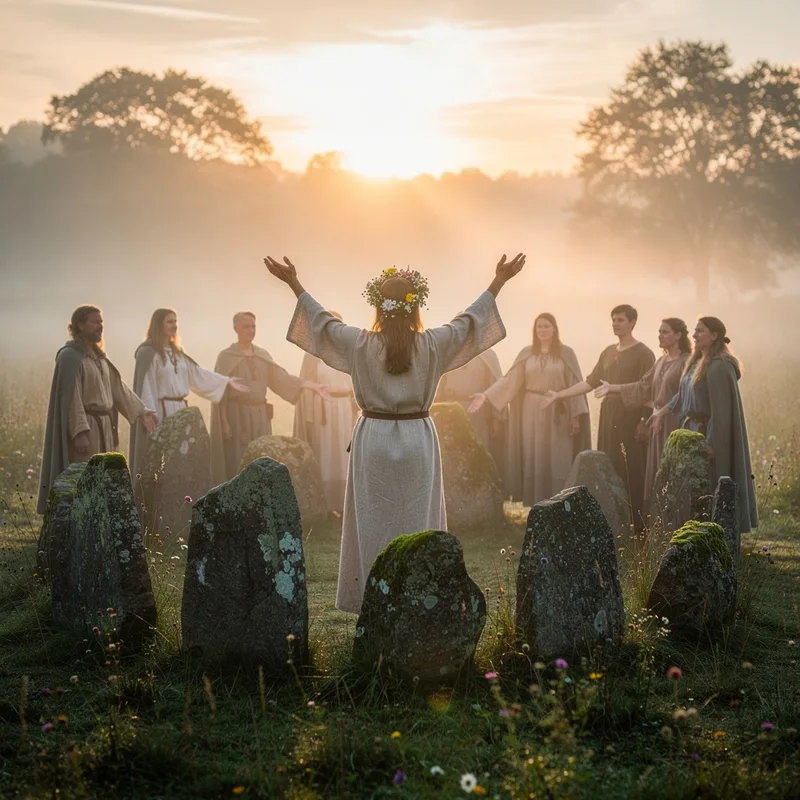
paganism
 7
7.9
7
7.9

- noun
- /ˈpeɪɡənɪzəm/
- American Catholics and Protestants alike view this as a heterodox display of fanaticism or paganism.
- paganism versus Christianity
- Roman paganism
- transition from paganism
Loading YouTube…
Watch on YouTubeAnd interestingly, they turned it against the temples of paganism.
- And interestingly, they turned it against the temples of paganism.
- So, for example, on the West Coast, nativists warned that the Chinese would bring paganism, incest and sodomy as well as miscegenation to America.
- So I talked earlier about the math, the math of slavery and paganism.
- The last part is called ends and there's this great essay in there, the end of paganism.
Examples
-
Rather, his opposition to God is one of paganism versus Christianity/Catholicism.
Academic text (1994) -
In paganism, women were worshiped as a route to heaven, but the modern Church has a monopoly on that in salvation through Jesus Christ.
-
In short, paganism referred to a highly competitive market for religion in the Roman Empire.
Academic text (1992) -
The return to Gala is a return to the enchanted, natural, animistic world of paganism.
Academic text (1997) -
Moreover, the surviving evidence with which we might reconstruct an accurate picture of preliterary paganism is so slight.
Academic text (1993) -
Julian persecutes Christians mercilessly, and miracles reveal the error of his promotion of paganism.
Academic text (2018) -
Aquinas successfully appropriated the ideals of Aristotelian science without adopting the paganism of which his contemporaries were so suspicious.
Academic text (2010) -
Finally, in 392, the Emperor Theodosius I made the practice of paganism effectively illegal (Huttmann 1967, p. 216).
Academic text (1992) -
Many ancient cultures practiced paganism, honoring multiple gods and nature.
-
The festival celebrated by the community reflected their paganism with rituals and traditions passed down through generations.
Synonyms
 1
7.4
1
7.4
Beliefs and customs from older religions not part of the main world faiths, often with many gods
 1
7.2
1
7.2
A set of beliefs and actions that worship many gods or nature

Lands and people who do not follow Christianity

An old word for the religious beliefs of people who are not Jewish
Antonyms


How Organized

Surface Forms
Morphology
Etymology
Paganism comes from the Latin word paganus, which meant 'country person' or 'villager'. Because people in the country often kept older local beliefs longer than the towns, paganism came to mean religious practices that are 'outside the main religions' or old folk traditions.