
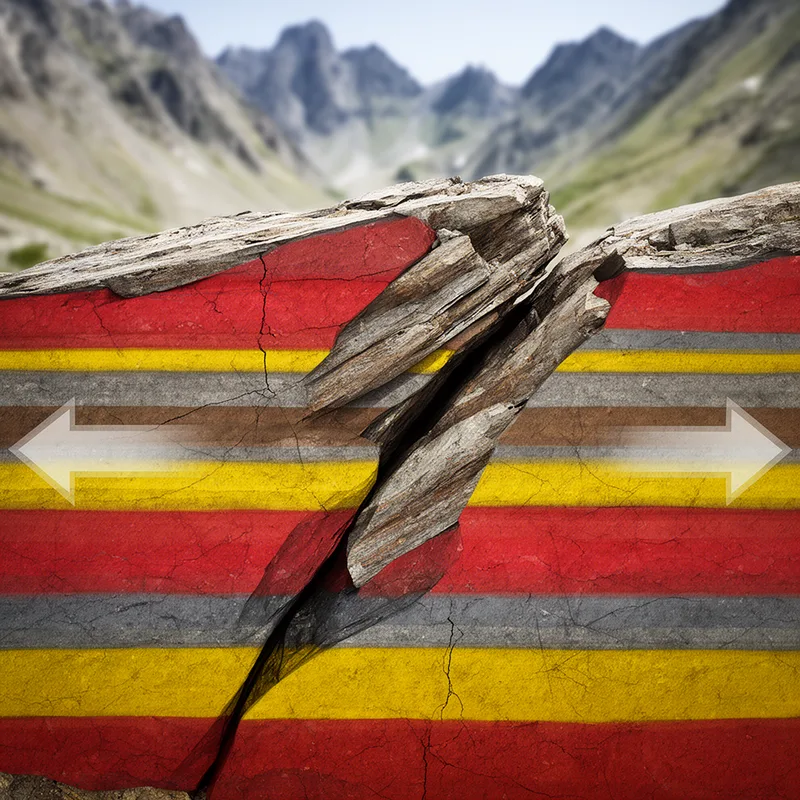
overthrust fault
- noun
- /ˈoʊvərˌθrʌst fɔlt/
- Specialized
- The geologists identified an overthrust fault running through the mountain range.
Examples
-
Evidence of an overthrust fault can be seen in the exposed rock layers.
-
Formation of an overthrust fault often results from intense tectonic forces.
-
The overthrust fault was discovered during the geological survey.
-
Geologists studied the overthrust faults in the Rocky Mountains.
-
The geologists identified an overthrust fault running through the mountain range.
-
Evidence of an overthrust fault can be seen in the exposed rock layers.
-
Formation of an overthrust fault often results from intense tectonic forces.
Synonyms

 63
6.1
63
6.1

A crack in the earth's crust where the ground has moved

 1
8.1
1
8.1
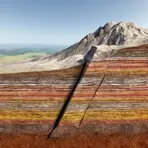
A break in rocks where the top part moves up over the lower part
 1
5.0
1
5.0
A crack in the Earth's crust where rock layers move
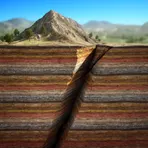
A break in rock where one side moves up when the land is pushed together
Surface Forms
Morphology
overthrust + fault
The compound is compositionally transparent: 'overthrust' reads as 'thrust over' (pushed over) and 'fault' is a tectonic fracture, so a learner who knows those constituent meanings can infer a fault where one block is pushed over another. Although the term is technical, its meaning follows regular English compounding and is derivable from the parts.
Etymology
Overthrust fault paints a clear picture: one block of rock is thrust, or pushed, over another along a break in the ground called a fault. So, it means a fault where the upper rocks have been 'pushed over' the lower rocks, which is why rock layers can appear on top of younger layers.