
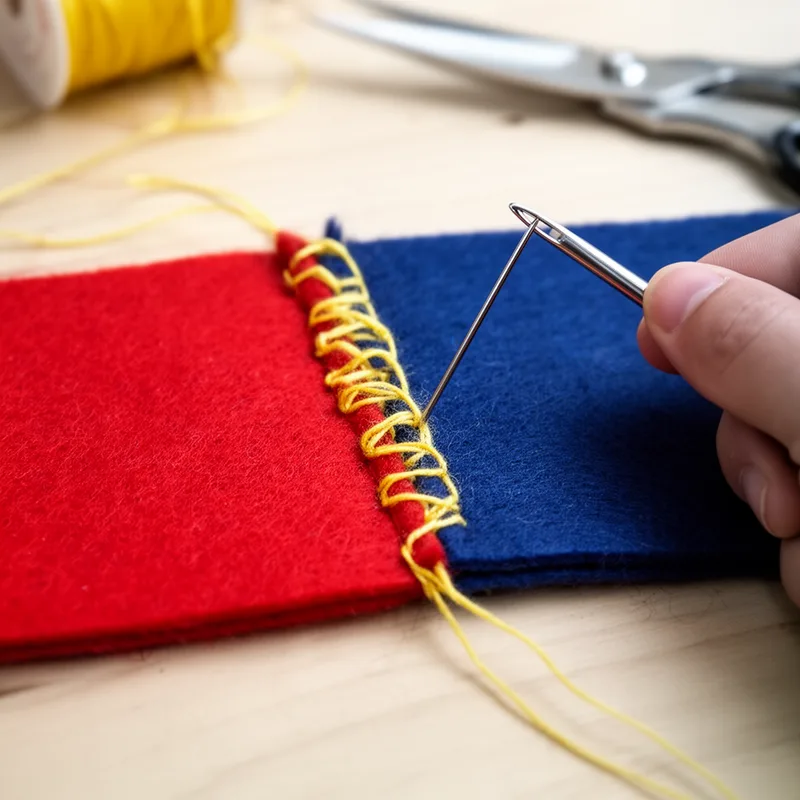
overhand stitch
- noun
- The instructions recommend an overhand stitch to secure the patches in place.
Examples
-
An overhand stitch is perfect for joining two pieces of felt together.
-
To finish the seam neatly, she used an overhand stitch along the raw edges.
-
She used an overhand stitch to join the fabric pieces.
-
The overhand stitches secured the hem effectively.
-
She used an overhand stitch to finish the edge of her dress.
-
To secure the two pieces of fabric, he made an overhand stitch along the seam.
-
The tailor demonstrated how to create an overhand stitch for repairing the hem.
Synonyms

 4
6.9
4
6.9

A hand stitch that goes over a fabric edge to stop it coming apart

A long stitch sewn over a fabric edge to stop it from coming apart

A long stitch you sew over a fabric edge to stop it from coming apart

A way of sewing that joins and finishes fabric edges by passing the needle at an angle over the edge
Surface Forms
Morphology
The meaning is directly compositional: 'stitch' is a sewing loop and 'overhand' signals that the action passes over the edge (a motion done over/with the hand), so together they describe a stitch made over the fabric edge. Although the term is somewhat technical within sewing, a B1 learner who knows both constituents can reasonably infer this literal sewing action without prior exposure.
Etymology
Overhand stitch comes from the simple picture of the needle and thread being passed over the fabric edge by hand, so each stitch wraps the edge and holds pieces together. That's why it is used to 'join' pieces or 'finish' a raw edge.