

overhand knot


 1
4.4
1
4.4
- noun
- /ˈoʊvərˌhænd nɑt/
- Felix has ascended more than 128,000 feet tied to a balloon, and I'm still trying to tie a double overhand knot.
- tie an overhand knot
Loading YouTube…
Watch on YouTubeA simple overhand knot is just the trefoil, the bowline knot.
- A simple overhand knot is just the trefoil, the bowline knot.
Examples
-
For a secure hold, make an overhand knot in the rope before starting the climb.
-
She showed me how to tie an overhand knot to secure the two ends of the string.
-
Most people call it a overhand knot, but we use this technique at work to tow.
-
We tied several overhand knots in the end of the rope we would be holding.
Academic text (1997) -
To prevent the beads from falling off, tie an overhand knot between them.
Synonyms
 95
1.0
95
1.0
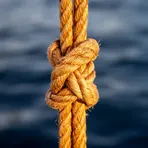
A fastening made by tying rope or string to hold things together
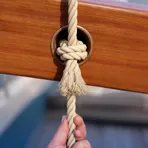
A way of tying the end of a rope to stop it slipping through a hole
How Secure
- Specialized
4
8.2

- Specialized
1
6.1
- Specialized
1
4.4
3
5.5
Surface Forms
Morphology
overhand + knot
The head noun 'knot' is fully transparent and 'overhand' evokes an 'over' motion applied with the hand, so a learner who understands the constituents can infer this is a simple knot involving an overing action of the rope. However, 'overhand' is a lexicalized, technical modifier whose exact tying procedure is somewhat specialized and not fully predictable from the parts alone, so the relation is only partially clear to a B1 learner.
Etymology
Overhand knot gets its name from the simple way you make it: you take the rope end over the rest of the rope and pull it through a small loop, a move like putting the rope over your hand. So this easy 'over the hand' action makes a tight little knot that 'stops' the ends from coming undone and is why the overhand knot is the basic secure or stopper knot.