

ovarian cyst
 3
4.8
3
4.8

- noun
- /oʊˈvɛəriən sɪst/
- Specialized
- Birth control pills—which are taken daily, regardless of how frequently a woman has sex—may also be taken to manage endometriosis, ovarian cysts, acne, or other health problems.
- remove an ovarian cyst
- ovarian cyst surgery
- ovarian cyst, endometriosis
Examples
-
She subsequently developed ovarian cysts and lost an ovary.
Blog text (22) -
The symptoms of a ruptured ovarian cyst include pain during the menstrual cycle.
Blog text (16) -
What did you say she had? - An ovarian cyst.
-
An ovarian cyst can look very much like pregnancy.
-
Ms. Fluke's friend was prescribed these birth control pills not for "sex" but to prevent ovarian cysts.
Blog text (22) -
Typically, the pain experienced during sex is not severe, but may be so if the person experiencing it has an underlying medical condition such as an ovarian cyst or urinary tract infection.
Blog text (28) -
What are ovarian cyst rupture symptoms? The signs related to a torn or ruptured ovarian cyst are quite the same as those of a regular ovarian cyst.
Blog text (16) -
The doctor informed her that she needed surgery to remove an ovarian cyst that was causing her discomfort.
-
After the ultrasound, the technician confirmed that I had an ovarian cyst which required monitoring for any changes.
-
Many women experience pain related to an ovarian cyst, especially during their menstrual cycle.
Synonyms
 30
4.9
30
4.9
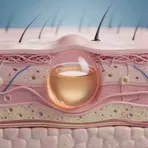
A small sac in the body often filled with fluid
Surface Forms
Morphology
The term combines 'ovarian' (pertaining to the ovary) with 'cyst' (a fluid-filled abnormal sac), so its meaning—a fluid-filled sac on or inside an ovary—is directly derivable from the constituents. This is a compositional medical noun phrase rather than an idiom, and the same logical construction appears in many languages, so a B1 learner who knows the component words would understand it.
Etymology
The compound noun ovarian cyst combines ovary, the female organ that makes eggs, and cyst, a 'small sac' filled with fluid. Picture a tiny water balloon on an ovary, and that's why the term means a fluid-filled sac on or in an ovary.