
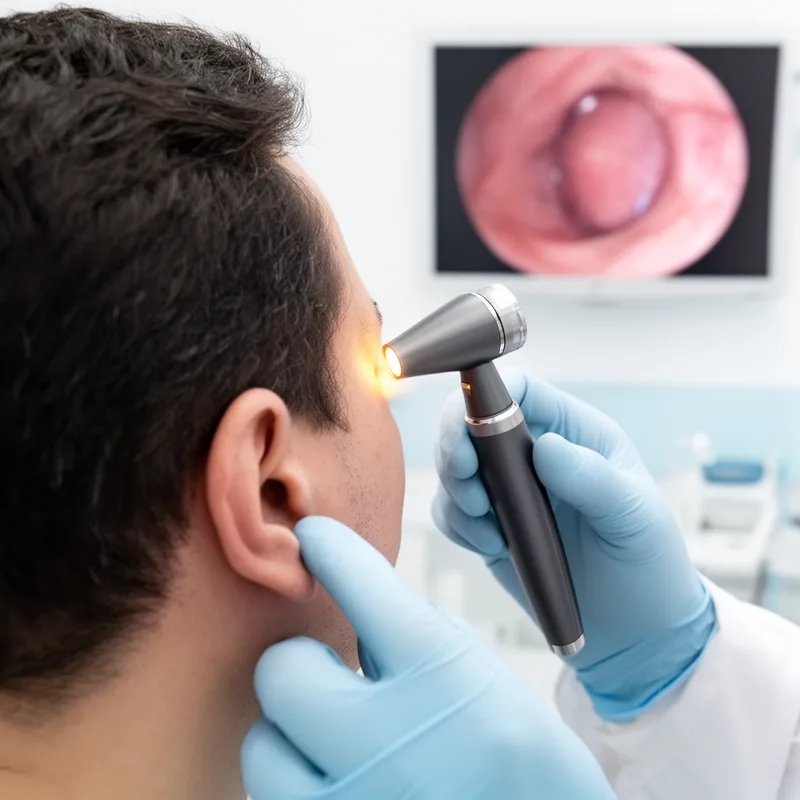
otoscopy


 1
6.5
- noun
- /əˈtɑːskəpi/
- Specialized
- The doctor performed an otoscopy to check for any issues in the patient's ear canal.
- pneumatic otoscopy
- otoscopy and tympanometry
- video-otoscopy
Examples
-
During the otoscopy, the specialist noticed some wax buildup in the eardrum.
-
We recommend that video-otoscopy be used whenever possible.
Academic text (2008) -
There was no variation in sensitivity and specificity among testers for otoscopy and tympanometry.
Academic text (1998) -
The primary outcome measures were resolution of otorrhoea and healing of tympanic membranes on otoscopy by 8, 12, and 16 weeks after induction.
Academic text (1998) -
Otoscopy revealed a polypoid growth emanating from a right central tympanic membrane perforation.
Academic text (2008) -
All patients provided a thorough ENT history, and all underwent a thorough ENT examination by direct otoscopy and, when necessary, microscopy.
Academic text (2006) -
Otoscopy revealed an auto mastoid cavity with extensive edema, granulation tissue, and exposed bone.
Academic text (2009) -
Diagnostic tests include pneumatic otoscopy, audiometry (including tympanometry), and acoustic reflectometry.
Academic text (2004) -
Saeed et al. compared the value of otoscopy, tympanometry, and tympanocentesis in detecting AOM, with and without effusion, in 90 children.
Academic text (2005) -
Before diagnosing the infection, the physician conducted an otoscopy of the patient's ear.
Surface Forms
Morphology
otoscopy = otoscope (semi-transparent) = oto + scopy
The relation between 'otoscope' (instrument) and 'otoscopy' (examination) is regular and predictable, but both elements are technical combining forms unfamiliar to average learners.
Etymology
Otoscopy breaks into oto- meaning 'ear' and -scopy meaning 'to look' or 'examine', like in microscope and telescope. So otoscopy is 'looking into the ear', which is why it means a medical examination of the ear with an otoscope.