
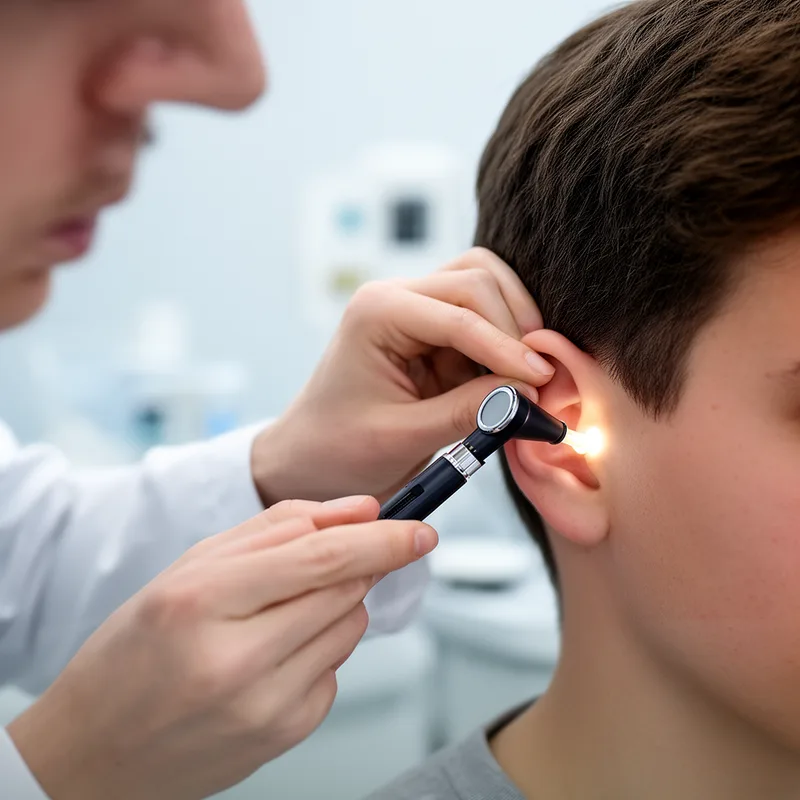
otoscopic
- adjective
- /ˌoʊtəˈskɒpɪk/
- Specialized
- Otoscopic examination revealed retraction of the left tympanic membrane.
- otoscopic examination
- otoscopic findings
- otoscopic videos
Examples
-
Otoscopic findings were normal in 74 patients (47.4%).
Academic text (2004) -
Otoscopic image shows the clinical appearance of Aspergillus otomycosis.
Academic text (2008) -
Diagnosis may be further enhanced by obtaining otoscopic photographs for use in consultation.
Academic text (2005) -
According to the otoscopic examination carried out, 77% of Garage I workers and 89% of Garage II workers had abnormal ears.
Academic text (1994) -
First-line management should entail observation and screening by otoscopic and tympanometric examination every 2 to 4 weeks over a period of 2 to 3 months.
Academic text (2001) -
Treatment efficacy was determined by comparing differences in pre- and post-treatment air-conduction thresholds and otoscopic findings.
Academic text (2005) -
Criteria for success included a subjective improvement in hearing, findings on otoscopic examination, closure of the air-bone gap, and type A (peak) tympanography results.
Academic text (2001) -
Patients were diagnosed and selected for surgery on the basis of their history, otoscopic examination, audiometry and tympanometry results, postnasal space x-ray findings, and their failure to respond to at least 3 months of medical treatment.
Academic text (2001) -
Efficacy was determined by comparing pre- and post-therapy air-conduction thresholds, tympanometric peak pressures, and otoscopic findings.
Academic text (2005) -
The doctor performed an otoscopic examination to check for any signs of infection in the patient's ear.
Surface Forms
Morphology
Etymology
Otoscopic comes from Greek parts oto- meaning 'ear' and -scopic meaning 'to look', the same 'look' you find in telescope and microscope. So, otoscopic is used for 'looking into the ear', for example when a doctor examines the ear with an otoscope.

