
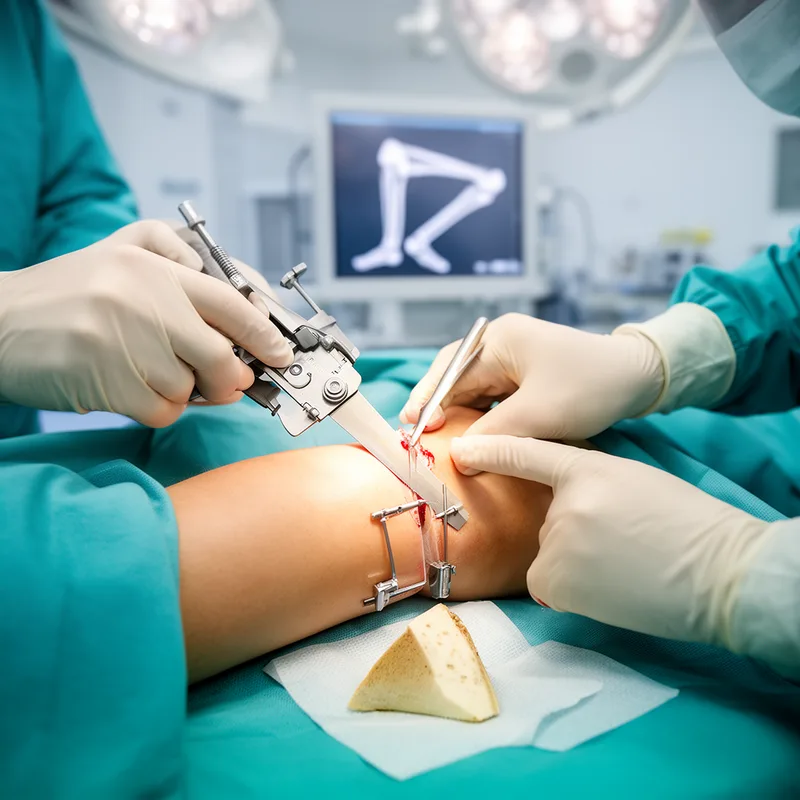
osteotomy
- noun
- /ˌɑːstɪˈɒtəmi/
- Specialized
- During the surgery, the surgeon performed an osteotomy to realign the broken bone.
- lateral osteotomy
- mandibular osteotomy
- tibial osteotomy
Examples
-
Functional outcome after high tibial osteotomy (HTO) was evaluated with respect to both improvement and goal achievement.
Academic text (2000) -
Two main treatments have been available: closed wedge osteotomy and dome (vault) osteotomy.
Academic text (2000) -
The lateral osteotomy is performed close to the face of the maxilla.
Academic text (1995) -
Bone grafts are placed at the osteotomy sites to facilitate bony union.
Academic text (1999) -
To maintain dental occlusion, either arch bars or orthodontic bands are required prior to osteotomy.
Academic text (1999) -
Fort I maxillary osteotomy (figure) is performed above the apices of the teeth.
Academic text (1999) -
A facial scar can be avoided by using the Le Fort I osteotomy, but this technique requires fixation of the alveolar ridge.
Academic text (2010) -
Phase I procedures include nasal reconstruction, mandibular osteotomy with genioglossus advancement, and hyoid myotomy and suspension.
Academic text (1999) -
Phase I surgical protocol includes nasal reconstruction, mandibular osteotomy with genioglossus advancement, and hyoid myotomy and suspension.
Academic text (1999) -
He required an osteotomy to correct his leg's length discrepancy after the injury.
How Invasive
- Specialized
 34
6.5
34
6.5


- Specialized
- Specialized

 1
7.4
32
3.0
1
7.4
32
3.0
- UK
3
3.7
Surface Forms
Morphology
osteotomy = osteo (semi-transparent) = osteo + otomy
The term literally combines 'osteo-' (bone) and '-otomy' (cutting), so the structure predicts 'cutting of bone', but these are specialized combining forms unfamiliar to average B1 learners.
Etymology
Osteotomy comes from two parts: osteo- meaning 'bone', as in osteoporosis, and -tomy meaning 'cutting'. So an osteotomy is literally a surgical 'cutting of a bone' to shorten, lengthen, or change its position.