
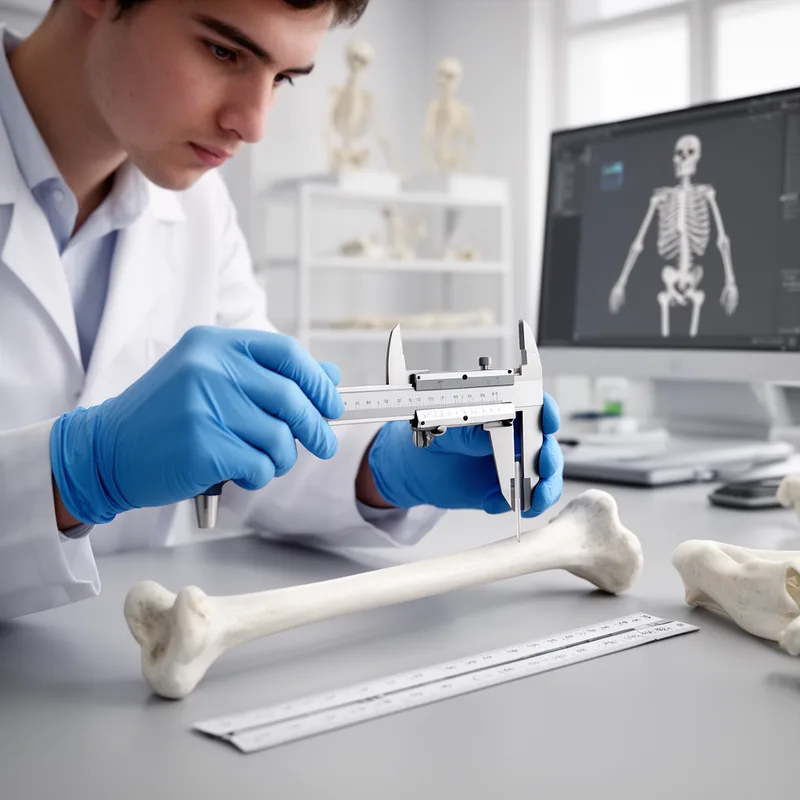
osteometry
- noun
- /ˌɑːstɪˈɒmətri/
- Specialized
- The significance and importance of somatometry, cephalometry, craniometry, and osteometry in the identification of human remains have been described, and a new term 'forensic anthropometry' has been coined.
- osteometry, including craniometry
Examples
-
Anthropometry can be subdivided into somatometry, including cephalometry, and osteometry, including craniometry.
Academic text (2007) -
However, the nasal septum remains a much-neglected area of osteometry.
Academic text (2009) -
Osteometry
Academic text (2007) -
Osteometry plays a crucial role in understanding human evolution by measuring the dimensions of ancient bones.
-
In medical studies, osteometry is often used to assess bone density and structure in patients.
-
The course on osteometry covers various techniques for accurately measuring skeletal remains.
Surface Forms
Morphology
osteometry = osteo (transparent) = osteo + metry
Formed from the combining form 'osteo-' (bone) plus the productive suffix '-metry' (measurement), directly meaning 'measurement of bones'.
Etymology
Osteometry comes from the Greek parts osteo- 'bone' and -metry 'measure', like the -metry in thermometer. So osteometry is the measuring of bones to study their size, growth, and health.

