
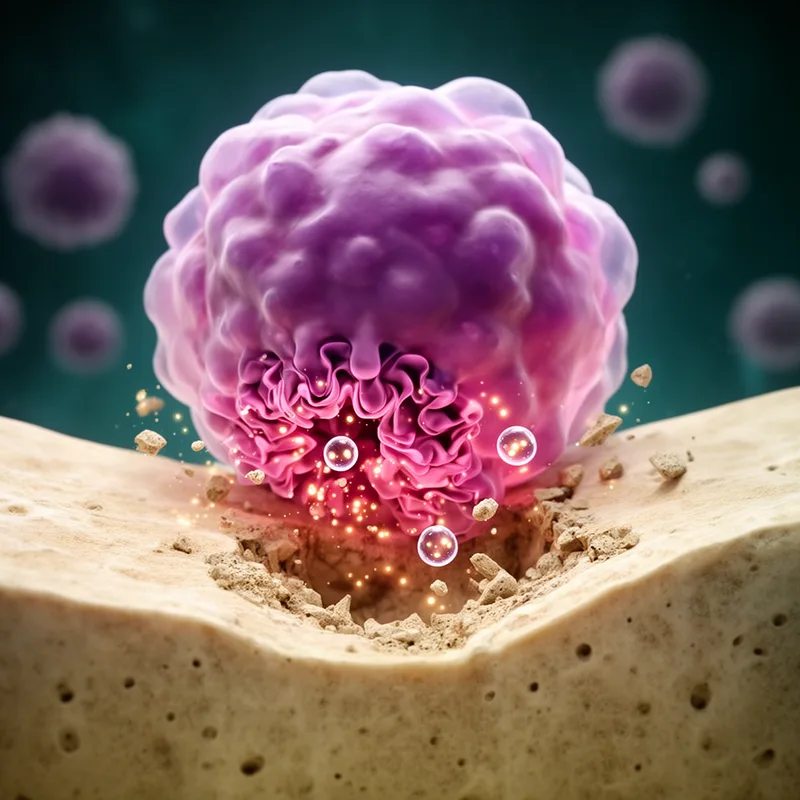
osteoclast
 1
9.2
1
9.2

- noun
- /ˈɑstiəˌklæst/
- Specialized
- The basic issue is the necrosis of osteoclasts, which are necessary for bone remodeling.
- osteoclast activity in bone
- osteoclast activity
- osteoclast cells
Loading YouTube…
Watch on YouTubeYour jaw isn't the only place where these osteoclasts and osteoblasts alter your bone structure.
- Your jaw isn't the only place where these osteoclasts and osteoblasts alter your bone structure.
Examples
-
This means they act on osteoclasts to try to slow the resorption of 'old' bone.
Academic text (2015) -
Over time, our bones will recruit what we call osteoclast cells that breakdown bone.
-
One is called osteoclasts and the other is called osteoblasts.
-
What you can do is you can stop the osteoclasts from cleaving the bone, right?
-
In remodeling, bone is resorbed by specialized cells known as osteoclasts.
Academic text (2004) -
What we now realize is that lack of estrogen causes increased numbers and activity of osteoclasts, which remove and destroy more bone during the remodeling process than needed.
Academic text (2007) -
Bone is living tissue, which constantly remodels through a cycle of turnover, where osteoclast cells remove old bone and new bone is laid down by osteoblasts.
Academic text (2015) -
Osteoporosis occurs when the breakdown (resorption) of bone caused by osteoclasts is greater than the buildup of bone by osteoblasts.
Academic text (2007) -
Bisphosphonates inhibit osteoclast activity in bone resorption, reduce bone turnover, and maintain calcium in bone (Gutierrez & Queener, 2003; Skidmore-Roth, 2003).
Academic text (2004) -
Osteoclasts play a crucial role in maintaining bone health by breaking down and absorbing old osteoclast tissue.
Surface Forms
Morphology
osteoclast = osteo + clast (opaque) = osteo + clast
Both 'osteo' and 'clast' are combining forms not used as standalone English words, so the meaning is opaque for most learners.
Etymology
Osteoclast comes from the Greek parts osteo- 'bone' and -clast 'break'. Think of it as a 'bone-breaker' cell: it breaks down old bone so the body can remove and replace it, which is why too much osteoclast activity can make bones weak.